
The word "transformative" is often overused in business, but in the case of Enovis it truly fits. In less than 10 years, the company transformed from a publicly traded manufacturer of fluid-handling products to a leading medical device company. The transition was powered by the strategic use of financial instruments. This was not a simple evolution. It was a complex, multi-year journey of divestments and acquisitions designed to reduce financial cyclicality and deliver more stable results through economic cycles. Such a transformation could have easily gone off course without strong financial controls. The Enovis transformation story offers practical advice for any company driving meaningful change.
-
"You have to make sure that what you're thinking of doing is aligned with the strategic goals of the company," said Katriona Knaus, Vice President of Finance and Treasurer at Envois. "Finance can't drive the strategic plan, it's operationally driven. We're not gatekeepers, but more like guardrails to keep the company aligned with its strategy."
Making a Strategic Pivot
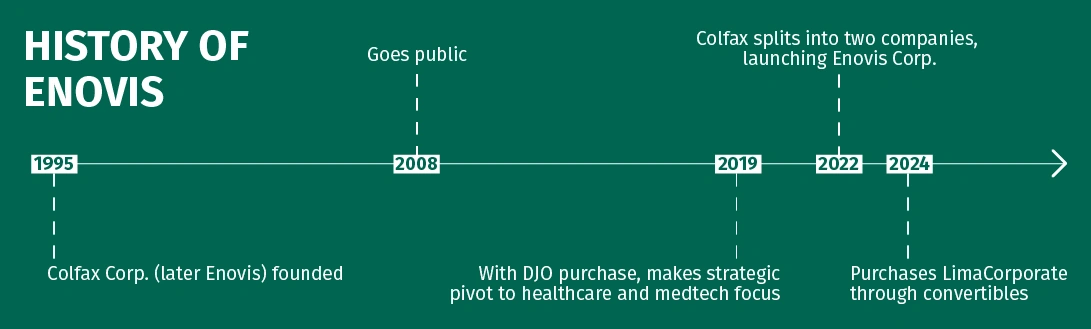
Enovis (formerly Colfax) started back in 1995 with an initial focus on industrial pumps. After going public in 2008, Colfax grew through acquisitions, expanding its product line, and eventually making a strategic pivot in 2019 to focus on the healthcare and medical technology sectors. It purchased DJO Global, a leader in orthopedic solutions, rehabilitation products, and surgical implants.
The goal of the purchase was to counterbalance some of the financial cyclicality associated with the heavy industrials, explained Katriona Knaus, Vice President of Finance and Treasurer at Envois. Unfortunately, she said, the market didn't value the diversity in the portfolio or understand how med tech assets would benefit the company by stabilizing results. In 2022, Colfax made a decisive move —splitting into two companies and launching Enovis Corporation with a singular focus on medical technology. Since then, Knaus has worked closely with Enovis's mergers and acquisitions team to grow the company.
Leveraging Financial Instruments
As Enovis acquired companies, Knaus continued the company's long history of using financial instruments to achieve its ambitious strategic goals. Enovis often tapped bank partners to help determine the right mix of financial instruments given the market environment—and explain the rationale to the board. Solutions include public debt and equity linked securities, foreign exchange (FX) trading and convertible financing.
-
"Communication is important. Communicating with the board is a lot different than communicating with management, which is an awful lot different than communicating with your back office," Knaus said. "You need a lead bank partner that is very comfortable with those board-level discussions."
A great example was the use of convertibles to fund the acquisition of Italian medical device company LimaCorporate, a privately held global orthopedic leader focused on an innovative portfolio of implant solutions. Citizens helped arrange a $400 million convertible note issuance and a $200 million FX forward to support the $860 million deal. Despite the long history of deal making at Enovis, convertible financing was new to the current board. Knaus leveraged insights from Citizens to educate the board on the merits of these instruments, which offer a lower interest rate than traditional debt but may dilute shareholders in the future.
A few months later, Citizens helped Enovis close a $125 million, four-year US dollar - Swiss franc cross-currency swap . The transaction is part of Enovis's strategy to align the currency mix of its liabilities with the profile of its revenue generating net assets globally. The swap is designated as a net investment hedge, enabling the company to take advantage of the favorable interest rate differential between the US and Switzerland. Enovis thus reduced net borrowing costs by approximately 3.2% per year.
Advice for companies considering financial instruments to support strategy
Knaus has seen firsthand what it takes to navigate complex transformations. Her advice is simple but powerful — surround your company with strong banking partners, and make sure one serves as a trusted lead.
- Make sure any acquisition—and the financing necessary—aligns with the strategic goals of the company.
- Do your homework. Ensure you understand the financial instruments and consider the market environment to avoid unintentionally creating new exposures.
- Prepare financing ahead of time, so if market conditions change the company has more flexibility to act. Have a Plan B ready in case the market is not favorable.
- Maintain regular communication with long-standing relationship banks to leverage their expertise, get various perspectives and ensure the best possible pricing.
- Plan the communication strategy carefully for the board, for senior managers, colleagues and other stakeholders.
By following the principles highlighted above, Enovis achieved greater stability, is on pace to meet its financial targets, and can devote its energy to innovations that enhance healthcare, patient care and outcomes.
Terms to know
- Financial Instruments – Tools like debt, equity, and derivatives to fund or manage risk.
- Convertible Notes/Financing – Debt that can turn into equity, lower rates but potential dilution.
- Cross-Currency Swap – Exchange of debt in one currency for another to match revenues.
- Equity-Linked Securities – Capital raised with instruments tied to company stock.
- FX Forward – Locking in a future currency exchange rate.
- Net Investment Hedge – Using derivatives to protect foreign operations from FX shifts.
- Public Debt – Bonds sold to investors to raise capital.
Related Reading

Financing for Growth and Efficiency
Discover how successful capital planning starts with setting your business strategy and then pursuing the right financing to drive those objectives.

Parx Casino® leverages virtual card payments to efficiently manage a highly regulated industry
Discover how Parx Casino partnered with Citizens on a payment solution to enable timely payments and reduce administrative efforts and costs.

The public to private equity pivot continues
As the private capital ecosystem has expanded over the last 25 years, the private equity-backed company count has climbed, while the number of public companies has fallen sharply. Explore what these trends mean for midsized companies.
© Citizens Financial Group, Inc. All rights reserved. Citizens Bank, N.A. Member FDIC
“Citizens” is the marketing name for the business of Citizens Financial Group, Inc. (“CFG”) and its subsidiaries. “Citizens Capital Markets & Advisory” is the marketing name for the investment banking, research, sales and trading activities of our institutional broker-dealer, Citizens JMP Securities, LLC (“CJMPS”), Member FINRA and SIPC (See FINRA BrokerCheck and SIPC.org). Securities products and services are offered to institutional clients through CJMPS (CJMPS disclosures and CJMP Form CRS). Banking products and services are offered through Citizens Bank, N.A., Member FDIC.
Securities and investment products are subject to risk, including principal amount invested and are: NOT FDIC INSURED · NOT BANK GUARANTEED · MAY LOSE VALUE