
Download a print-friendly version of this report.
Published January 2026
Tailwinds drive confidence for M&A upswing to broaden
Key takeaways from Citizens 2026 M&A Outlook
The M&A market in the U.S. looks poised to build on 2025 trends, with conditions that could drive merger and acquisition activity beyond recent megadeals and into broader segments. A strong economic environment, lower interest rates and attractive valuations are key tailwinds for both companies and private equity (PE) firms. Upbeat expectations for these metrics are fostering an appealing setting for PE exits, succession transactions and growth acquisition. In the 2026 survey, companies and PE firms both display confidence in their outlooks for M&A activity.
Sentiment is strong for mergers and acquisitions in 2026
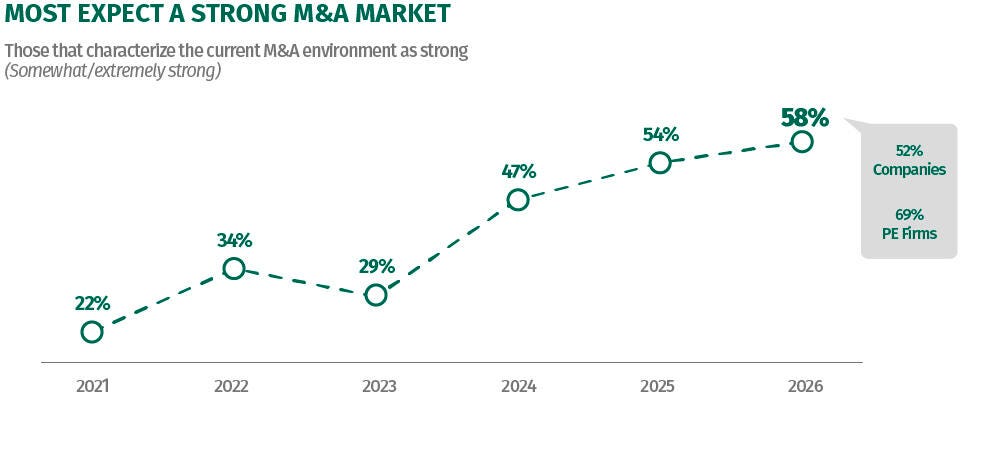
The strength of the M&A market is rated at a six-year high in Citizens' 2026 survey of 400 U.S. companies and PE firms that invest in companies with revenue between $50 million and $1 billion. 58% of respondents assess the M&A market as somewhat or extremely strong. PE firms are especially positive, with 69% seeing a strong M&A market. While 2025 dealmaking lagged in the first half, it accelerated later in the year – momentum that could carry into 2026 and broaden activity across quieter pockets.
-
"We saw megadeals surge in 2025 as the operational environment stabilized, and we look at those transactions as leading indicators for the rest of the M&A market. The outlook for good deal conditions suggests more activity to come for broader segments in 2026."

Jason Wallace
Head of M&A
Key themes
Supportive economic backdrop to continue
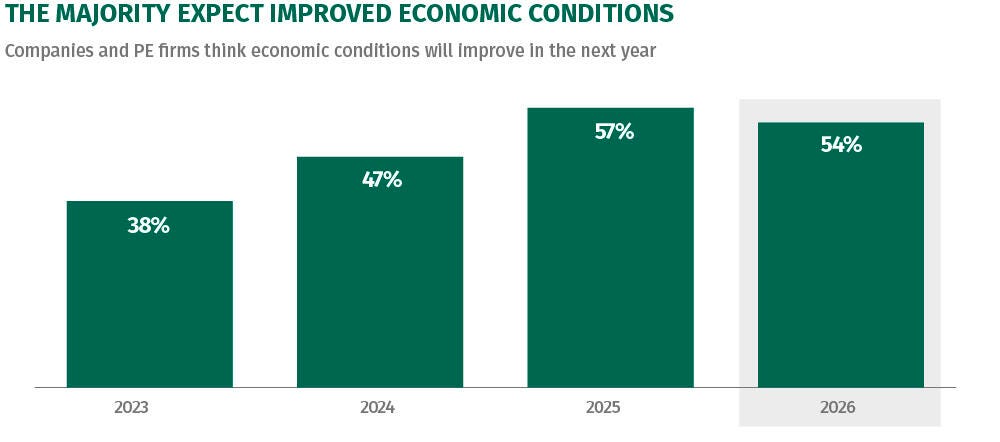
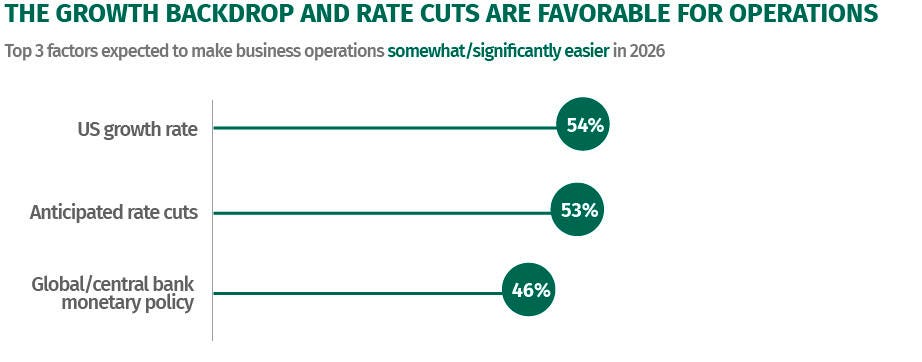
The U.S. economy proved resilient in 2025 after "Liberation Day" volatility, and the majority of companies have a positive outlook for economic conditions in 2026. Looking ahead, companies say economic growth and anticipated rate cuts are the top factors making operations easier in 2026. They also cite global monetary policy, the U.S. regulatory environment and easing inflation as positive influences.
-
"The business environment is critical for M&A as buyers and sellers need to have greater certainty regarding performance and forecasts. Economic growth, favorable interest rates and less volatile global trade dynamics set companies up for continued stability in the operational landscape."

David Dunstan
Head of Industrials, M&A Advisory
Though operational costs and challenges have weighed on many companies
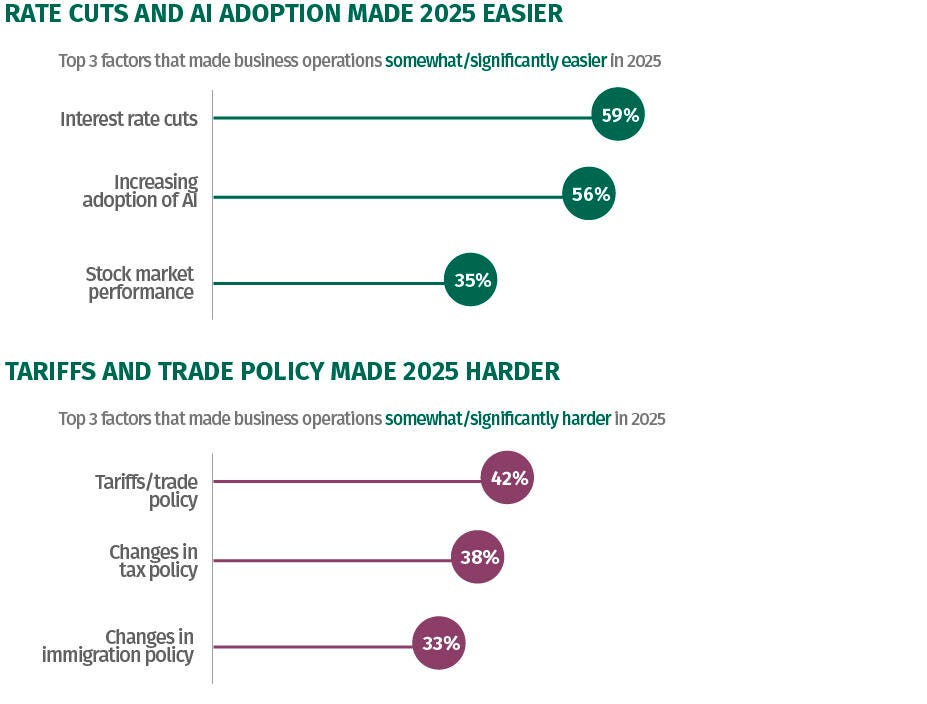
A key theme this past year was the pressure from rising input and commodity prices, as well as supply chain issues. 42% of companies said tariffs and trade policy were a challenge in 2025. They also pointed to changes in tax and immigration policies as headwinds.
Conversely, interest rate cuts made operations easier for six in 10 companies in 2025. More than half say that increasing adoption of AI made operations easier in 2025. This echoes separate findings from the Citizens 2026 survey of AI trends in financial management, where 82% of CFOs at midsize companies plan to increase their investment in AI tools.
Companies & PE firms are feeling good about valuations
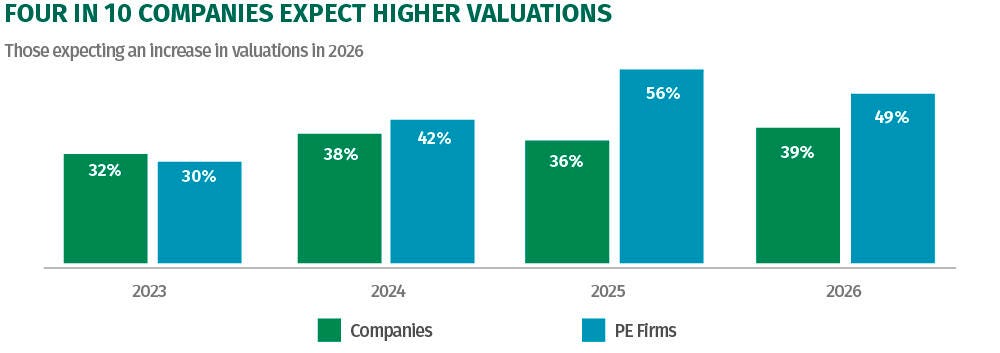
Appealing valuations are a major driver of M&A activity going into 2026. Companies have optimistic outlooks, with about four in 10 saying they expect valuations to go higher in the year ahead. PE firms are also upbeat, with half expecting higher valuations. Valuations firmed considerably over 2025. Across public equity markets, aggregate valuations improved in the second half of the year, nearing 2020 highs on a price/forward earnings basis.
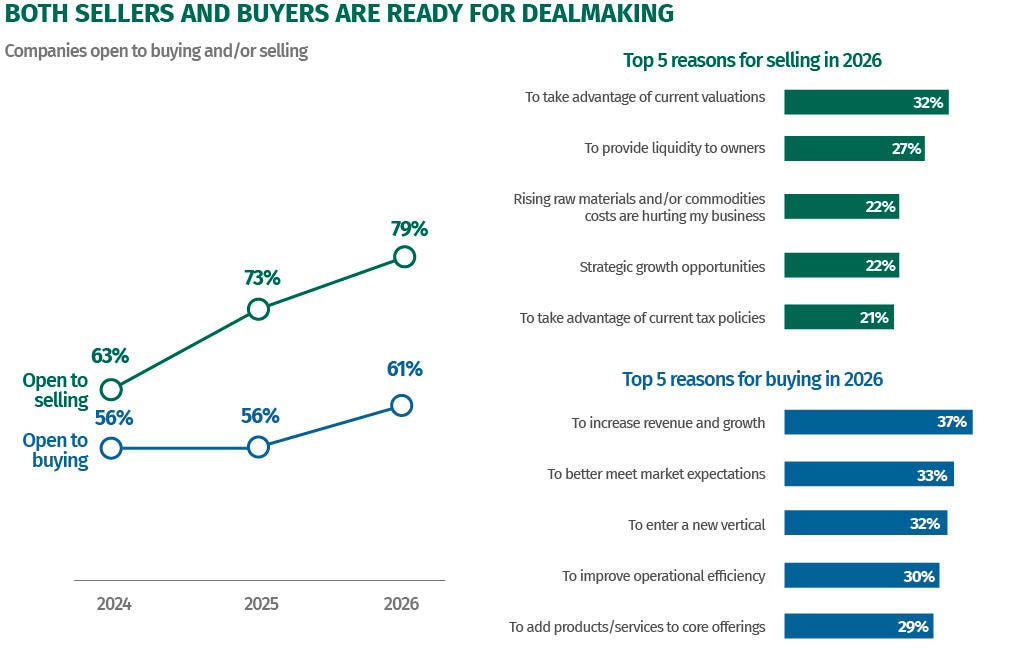
The number of companies who say they are potential sellers in 2026 surged to 79%. Would-be sellers point to valuations as their top reason for coming to market. It’s also notable that sellers are coming to market because of the pressures connected to trade/tariff policies. 22% of sellers say rising material costs are hurting their business, while 20% say supply chain issues are driving them to sell.
The buyer pool has also grown, with six in 10 companies saying they could be buyers in 2026. The prevailing reason for buying is to acquire revenue or sources of growth. Many buyers are considering their market position as they look for ways to meet market expectations or enter new verticals.
-
"We hear a growing call for liquidity among private equity investors, and 2026 could deliver the right conditions to bring that backlog to market. The improvement in valuations across most sectors is a major factor."

Mark Lehmann
Vice Chair Commercial Bank
TMT leads the valuation outlook again, while healthcare lags
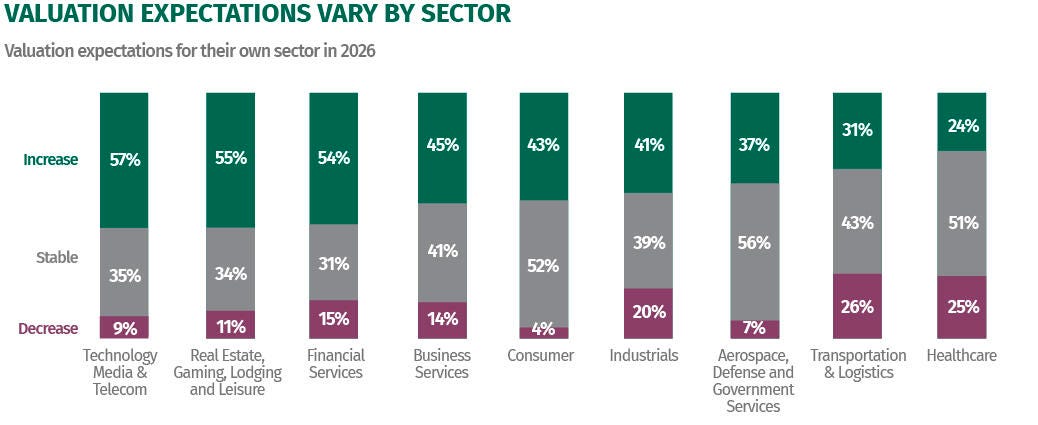
Technology, media and telecommunications (TMT) participants lead the outlook for valuations in 2026, with 57% reporting that they expect valuations to rise. Companies and PE firms in the real estate, gaming, lodging and leisure sector and financial services sector are similarly upbeat. At the other end of the spectrum is healthcare, where just a quarter of respondents anticipate higher valuations in 2026. The majority expect valuations in healthcare to remain stable, possibly reflecting an already-high level from 2025.
Across all sectors, the vast majority expect valuations to be stable or higher, with just a small portion expecting a decline in the year ahead.
-
"Sector valuation expectations mirror improving sentiment broadly, also likely reflecting the transition from an acutely complicated environment for certain segments of the market. It's notable how few participants expect softer valuations in 2026."

Devin Ryan
Managing Director, Equity Research
Private equity firms are confident about M&A decisions
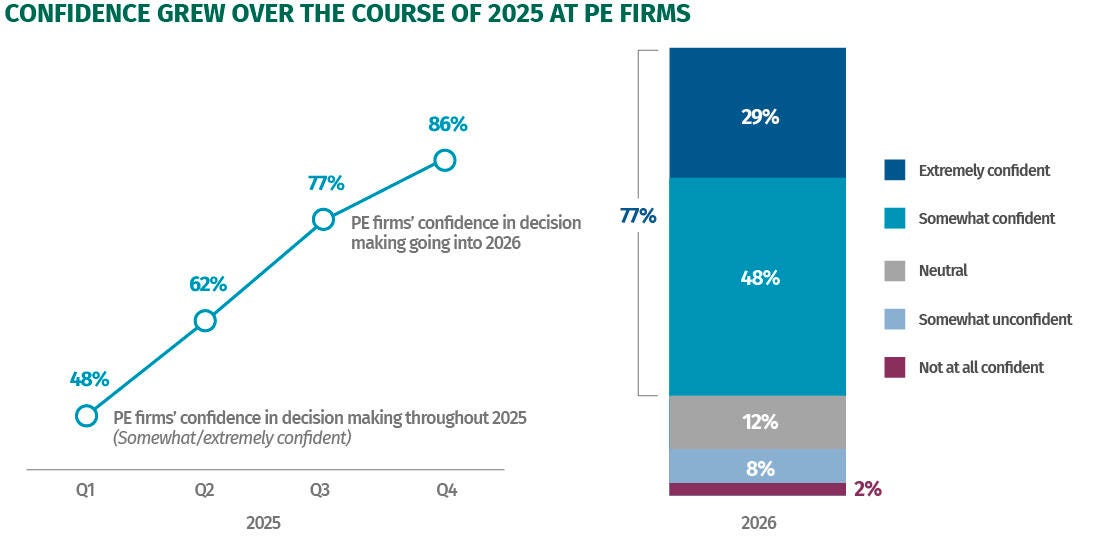
PE firms have a unique perspective on the M&A market, and there was a clear pattern of gathering confidence in this cohort in 2025. In the first quarter, 48% said they had confidence in M&A decision making; by the fourth quarter, 86% of PE firms were confident.
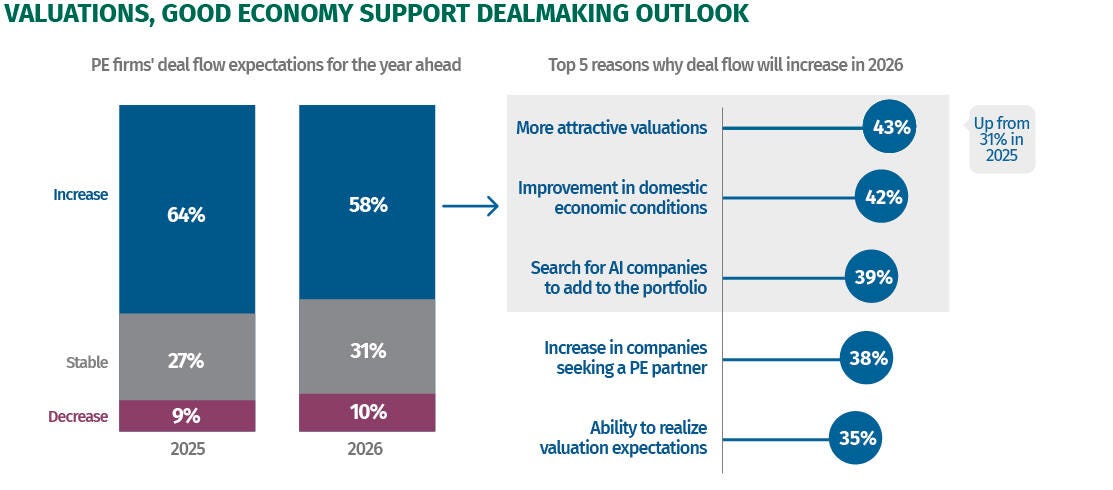
In 2026, the majority of PE firms expect deal flow to increase. The prospect of more attractive valuations is their top reason, but improvement in domestic economic conditions is another important booster. Interest in AI continues to drive market activity as well. Four in 10 PE firms say they anticipate deal flow arising from the search for AI companies or assets to add to their portfolio.
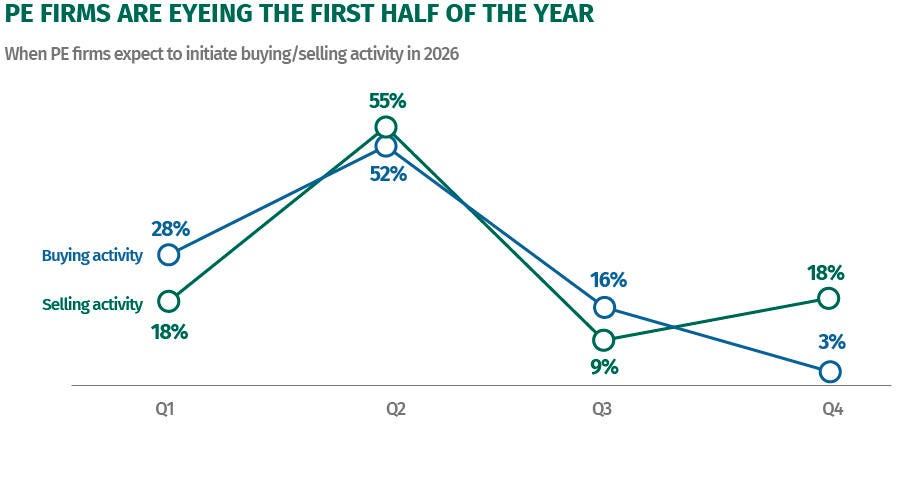
As they consider the year ahead, PE firms are planning action for the first two quarters of 2026. Most say they plan to initiate buying or selling activity in Q1 or Q2 of the year.
-
"The timeline for PE activity suggests a very ‘normal’ year for M&A, with PE firms planning to initiate deals early in the year and expecting to close before the end of 2026. This outlook should give confidence to both buyers and sellers about deal conditions."

Gavin Slader
Head of Corporate Finance
Good balance in buyer/seller dynamics
Companies and PE firms both assess the current market as a fairly balanced one in terms of the buyer/seller dynamics. "Equally balanced" is the most popular answer from PE firms, companies more commonly say it is a "seller's market."
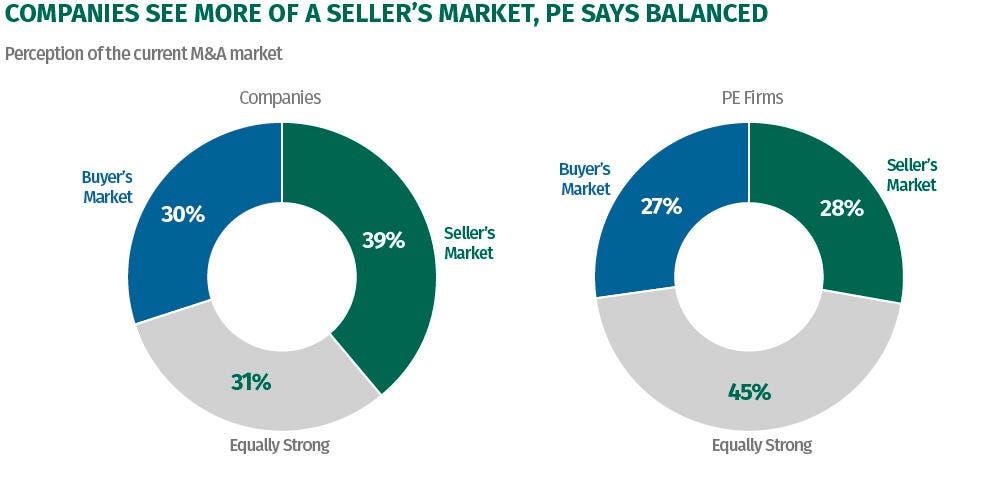
The sense of a seller's market could be attractive to companies that are watching for the right moment to sell for succession or exit purposes. In terms of transition plans, 19% of companies plan to sell while only 30% will handle a transition through a succession plan. Meanwhile, more than half say there is no plan for transition. These numbers are generally consistent with prior survey years, though there was an increase in 2026 among those who plan to sell (19% in 2026 versus 14% in 2025). The appealing valuation environment could be driving the uptick in those who will handle a transition by selling their company.

Key takeaways
While 2025 was a year when megadeal activity accelerated, the outlook for 2026 suggests that M&A activity could broaden to other segments of the market.
The core dynamics are quite favorable:
- An economy that has proven stronger than expected
- Higher valuations
- Softening interest rates
- Balanced buyer/seller dynamics
- An operating environment with less volatility and more certainty
The signs of confidence are widespread going into 2026, with upbeat outlooks from both companies and PE firms. Trade and tariff policies were a driver of uncertainty and a headwind for operations in 2025, but those challenges could actually be bringing more businesses to the M&A market amid an appealing backdrop for transactions. The search for AI assets also continues and could drive M&A activity at both PE firms and companies.
Actions to consider in 2026
- For companies considering a sale, assess your confidence level about recent performance and future forecasts. Companies who can speak confidently about expected 2026 performance are best positioned to begin the sale process.
- Begin to lay the groundwork for a sale by cleaning up financials and preparing for the due diligence process that buyers will undertake.
- Companies considering an acquisition also benefit from a bigger pool of sellers and buyers. Review your balance sheet and financing options now to establish readiness for the right acquisition.
- Expect a competitive market. The competition for quality assets is already significant. If interest rates soften and valuations remain steady, the market could become even more competitive.
Explanation of methodology
The Citizens 2026 M&A Outlook reflects data from the 15th annual survey of M&A decision-makers in the U.S. among companies with $25M to $1B in annual revenue. Research was conducted via a phone or web-based survey in November 2025, in partnership with an independent market research firm Escalent. The survey was conducted among 400 U.S.-based companies ($25 million to $1 billion in revenue), as well as PE firms (fund size less than $1.5 billion) that are active in the acquisition and sale of U.S.-based companies with revenue between $50 million and $1 billion. Respondents were selected to represent a mix of sectors and are not necessarily clients of Citizens.
Ready to take the next step? Get in touch with our team.
All fields are required unless marked as "Optional".
© Citizens Financial Group, Inc. All rights reserved. Citizens Bank, N.A. Member FDIC
“Citizens” is the marketing name for the business of Citizens Financial Group, Inc. (“CFG”) and its subsidiaries. “Citizens Capital Markets & Advisory” is the marketing name for the investment banking, research, sales and trading activities of our institutional broker-dealer, Citizens JMP Securities, LLC (“CJMPS”), Member FINRA and SIPC (See FINRA BrokerCheck and SIPC.org). Securities products and services are offered to institutional clients through CJMPS (CJMPS disclosures and CJMP Form CRS). Banking products and services are offered through Citizens Bank, N.A., Member FDIC.
Securities and investment products are subject to risk, including principal amount invested and are: NOT FDIC INSURED · NOT BANK GUARANTEED · MAY LOSE VALUE