
Life Sciences Outlook – A Cautiously Optimistic Investment Cycle

Key takeaways
- The life sciences market has normalized to pre‑pandemic trends, with capital deployment reflecting a more disciplined assessment of execution risk.
- Funding has shifted toward later-stage, derisked assets, as investors prioritize clinical validation and clearer paths to commercialization.
- Exit conditions remain constrained, with IPO activity selective and uneven despite early signs of reopening. As a result, M&A continues to serve as the primary liquidity pathway.
Life sciences investors currently face a market characterized by recalibration and renewed discipline. Innovation remains active, long-term demand drivers are intact, and capital is available, but decisions around deployment reflect a more disciplined assessment of execution risk and durability.
In retrospect, the sector's pandemic era peak was a transitory response to extraordinary macro conditions rather than a structural reset. Investment levels have since normalized to a steady state, broadly in line with pre-pandemic trends, reinforcing the view that the surge of 2020–2021 did not reset the market’s baseline.
This normalization reflects a fundamental shift in investor priorities. Across both private and public markets, capital is now concentrated in opportunities that demonstrate both clinical validation and a credible path to commercialization. Earlier-stage, high-uncertainty programs, while still essential to long-term innovation, are attracting a smaller share of incremental capital. The effects of this reprioritization are now visible across financing patterns, exit behavior, and investor participation.
Nishta Rao, Managing Director and Life Sciences Lead at Citizens Private Bank, offered her perspective on the sector’s outlook, drawing on her work with life sciences companies, investors, and strategic participants across the ecosystem. "What we're seeing in life sciences is a more disciplined market relative to clinical validation, commercialization timelines, and the path to liquidity," said Rao.
From expansion to disciplined growth
By 2023, public and private funding had retraced towards 2019 levels. While overall funding levels stabilized, the composition of that capital shifted in a meaningful way. During this time, late-stage venture financings consistently accounted for approximately one-third or more of total investment, reflecting a preference for derisked assets and shorter timelines to value inflection.
Three forces have driven this shift. First, the prolonged closure of the IPO window has required investors to support portfolio companies beyond traditional exit timelines. Second, both private and public investors have placed greater emphasis on clinical data to support valuations. Third, large pharmaceutical companies, facing significant patent expirations, have increased demand for late-stage and commercially proximate assets.
At the same time, the scale of late-stage financings attracted broader participation from generalist investors. While historically cyclical, this participation may prove more durable as the sector increasingly rewards execution against commercialization milestones in addition to scientific innovation.
"Late-stage financings reflect a market preference for derisked assets. In this market, the companies that can connect strong science to credible execution of milestones are better positioned to attract capital," Rao said.
VC investment leveled off
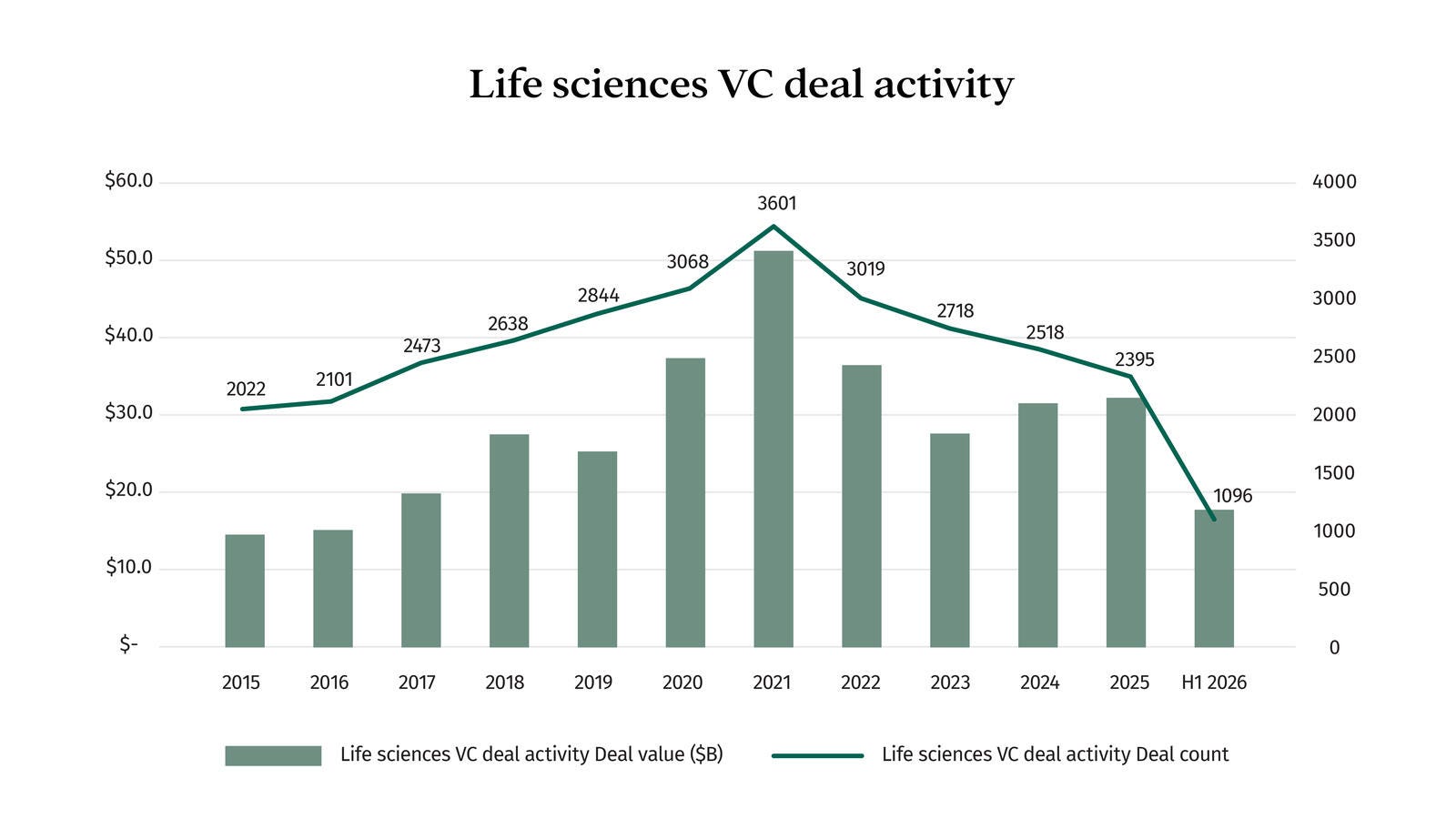
Taking a closer look at venture investment specifically, levels have remained relatively stable since the 2021 bubble. After dropping from $36.3B in 2022, total funding per year for 2023-2025 ranged from a low of $27.5B in 2023 to a high of $32.1B in 2025, illustrated in the chart.
Source: PitchBook | As of June 30, 2026
Global venture investment in life sciences reached approximately $51 billion in 2025, with early 2026 activity tracking at a similar pace. This stability, while notable, should not be mistaken for renewed expansion. Rather, it reflects a market in equilibrium, with capital deployment calibrated to a narrower set of investable opportunities.
Biotechnology continues to capture the largest share of VC funding, while digital health accounts for a greater number of transactions. Artificial intelligence has emerged as an important thematic driver with potentially transformative dynamics in therapeutic development and delivery, but its impact on capital allocation has been more incremental. Even in AI-enabled segments, clinical data remains one of the primary determinants of investor interest, particularly in later-stage rounds.
Overall, more than $15B in VC investment flowed to drug discovery companies (BYTE51). Late-stage investments (Series C and later) accounted for 34 percent of the total venture investment – not far off the 5-year average. There were 21 mega-rounds valued at more than $200M in the first quarter of 2026, according to data from BYTE51.
Exit pathways remained constrained
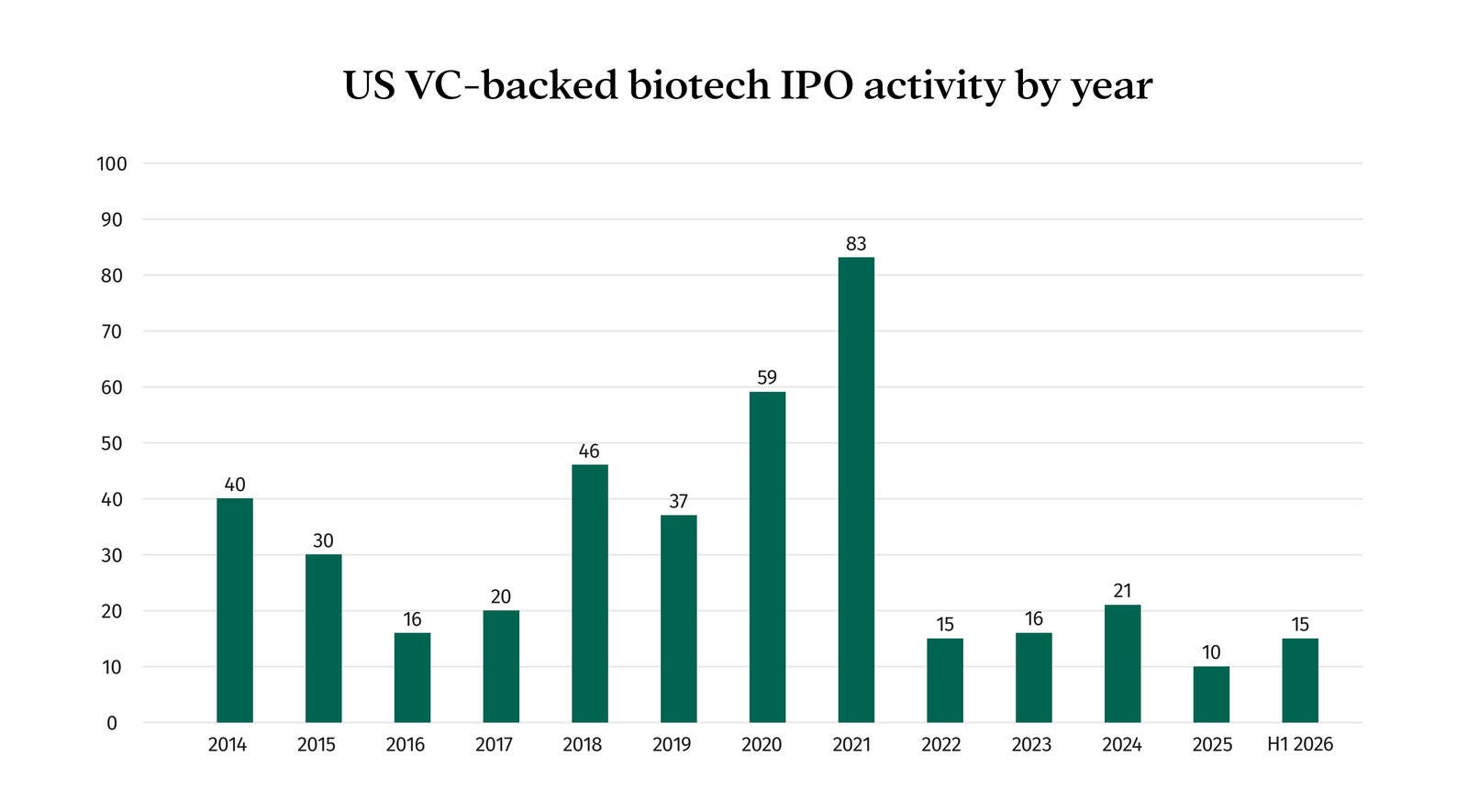
Exit dynamics lagged the broader capital market recovery in the years after the COVID-19 pandemic. IPO activity, which peaked in 2021, declined sharply and reached a low point in 2025. The retrenchment, termed a 'biotech winter' by many, reflected both the weak post-listing performance of the pandemic-era IPO cohort and persistent value gaps between private and public markets. 2025 marked the nadir for biotech IPOs with only 10 new US listings.
Source: PitchBook | As of June 30, 2026
Activity in the sector picked up late in the year, with five debuts in February 2026 alone. However, the market performance of the companies that listed in the first quarter has been uneven, and volatility in broader markets continues to constrain risk appetites. That said, some investors and analysts expect the IPO window to remain open, if highly selective, through the end of the year.
Mergers and acquisitions continued to serve as the primary liquidity pathway. Strategic acquirers remained active, particularly large pharmaceutical companies, driven by their need to replenish pipelines in advance of patent expirations and supported by strong cash positions. The final weeks of the first quarter witnessed a frenzy of dealmaking, valued by Endpoints at $31.5B, bringing the quarterly total up to $48B.
"Strategic buyers still need innovation, particularly as patent expirations put pressure on existing portfolios. That demand can create opportunity for M&A, especially in this selective IPO market," Rao said.
Public markets: early signals, limited conviction
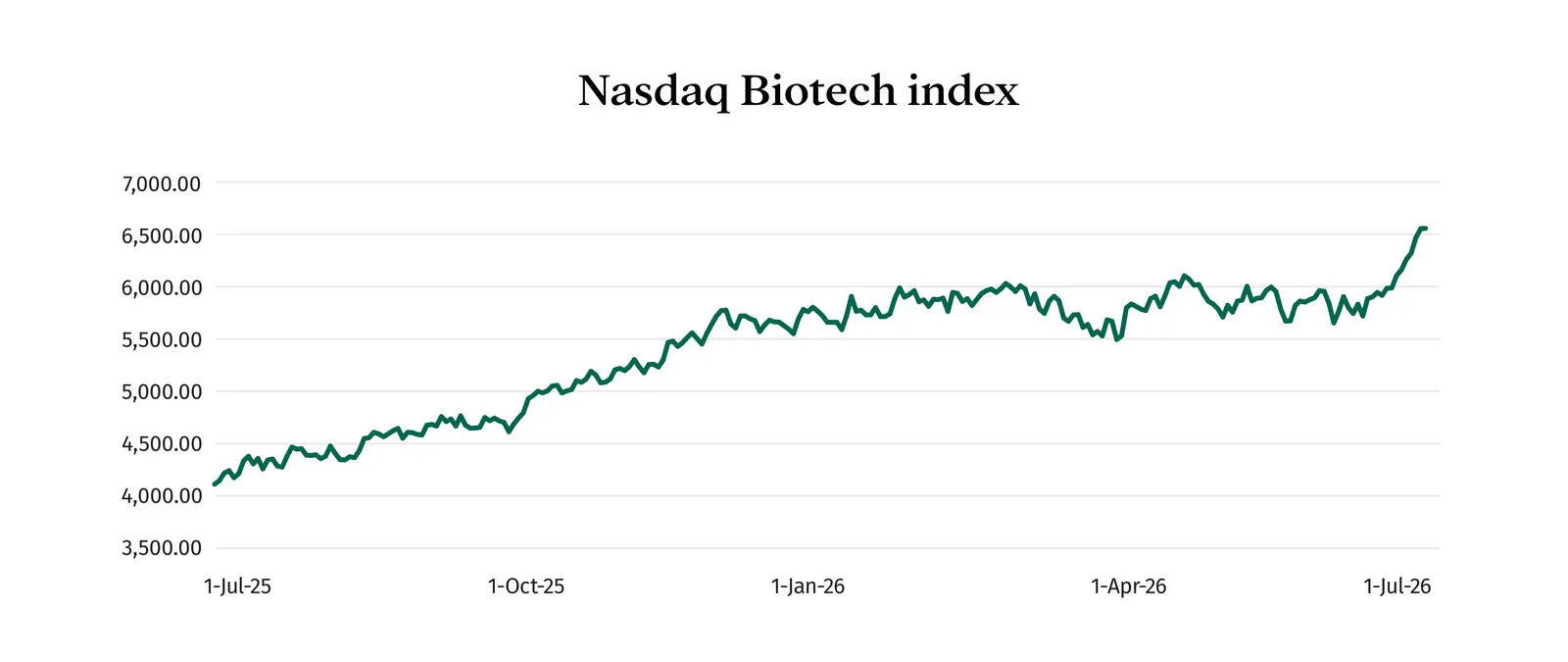
After moving largely in step with broader markets since the spring of 2025, the NASDAQ Biotech Index regained momentum in the second quarter of 2026 and climbed sharply into late June. Rapidly unfolding geopolitical and macroeconomic developments have created uncertainty across the broader market.
Follow-on financing activity has moderated from earlier elevated levels, though it remains robust relative to historical norms. Public markets are signaling cautious optimism, but conditions have yet to suggest a full return to pandemic era levels.
Source: Yahoo Finance | As of June 30, 2026
China's growing influence in the sector
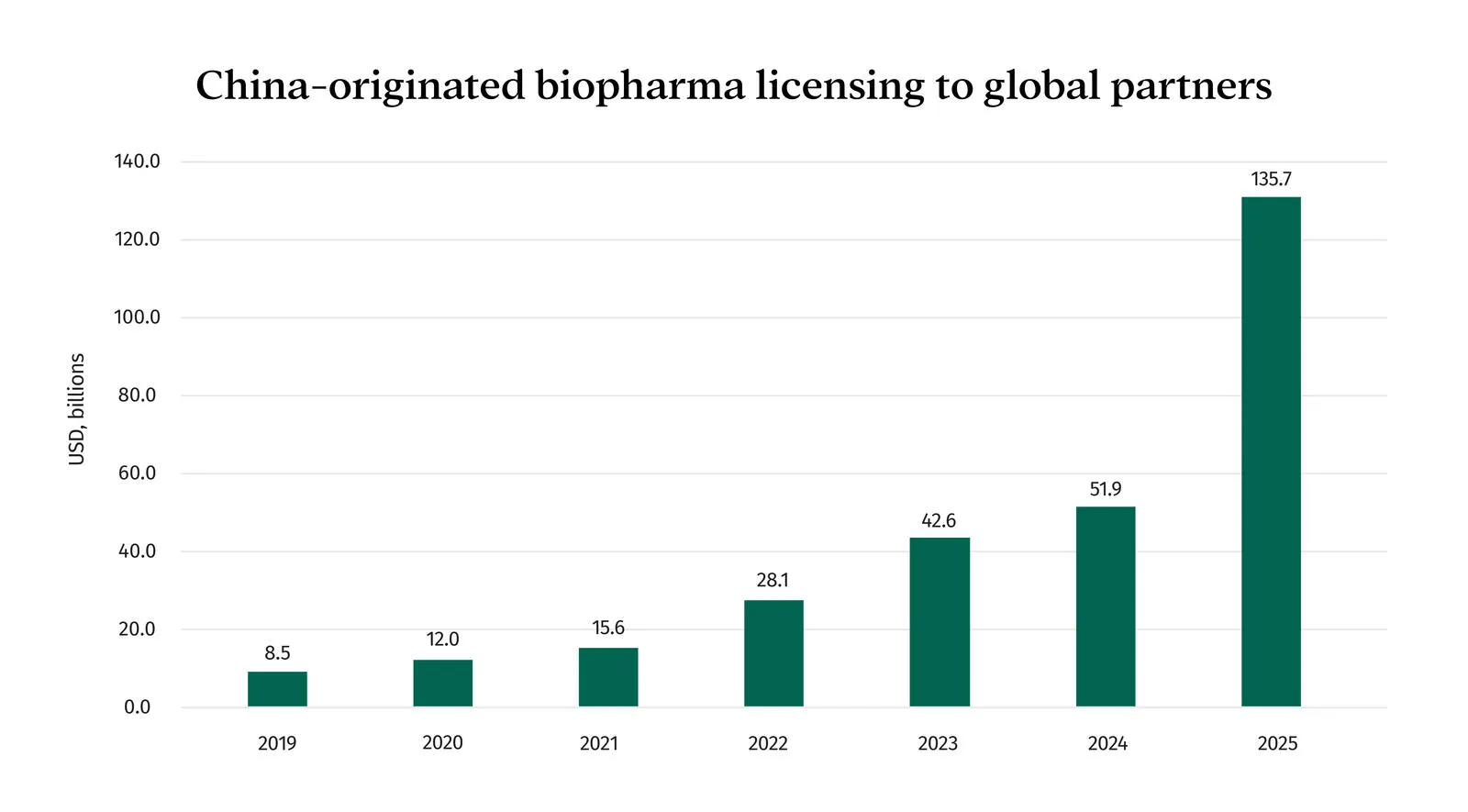
China is emerging as a significant source of biopharmaceutical innovation, altering geographic dynamics and capturing a growing share of global licensing activity and investment flows. Structural advantages in development speed and cost, combined with sustained policy support and regulatory modernization, are accelerating this shift and reshaping competitive dynamics.
China's influence is increasingly felt through the nature and maturity of assets entering global markets. In 2025, Chinese biopharmaceutical companies accounted for roughly one third of global out licensing deal value, with activity concentrated in later stage and clinically validated programs (Vision Lifesciences; GlobalData). Faster early phase clinical execution, large patient pools, and lower development costs have enabled Chinese developers to advance programs more rapidly to decision ready data. For global acquirers and investors, China has become an important source of incremental deal flow.
Sources: Public company disclosures and industry databases, including EY, Freshfields, ChemLinked, and PharmCube NextBiopharm®
Final thoughts: Key considerations for market participants
For investors, the current environment rewards selectivity and favors assets with clear clinical and commercial milestones. For companies, access to capital increasingly depends on the ability to generate differentiated data and articulate a credible path to market. For strategic acquirers, the environment remains conducive to sourcing innovation externally, particularly given ongoing patent pressures.
Looking ahead, a sustained reopening of the IPO market would represent the most significant inflection point for the sector, enabling capital recycling and supporting earlier-stage investment. Until then, the market is likely to remain characterized by disciplined deployment, late-stage concentration, and continued reliance on M&A as the primary exit mechanism.
"For founders, investors, and strategic acquirers, the takeaway is to stay focused on evidence. The market is still open to compelling science, but it is rewarding teams that can show why now, why this asset, and why this path to commercialization," Rao said.
Citizens Private Bank's life sciences and healthcare team remains closely engaged with investors, operators, and strategic participants across the sector's ecosystem, helping clients understand the sector-specific dynamics and evaluate opportunities as they emerge. For additional perspectives, please contact Nishta Rao.
© Citizens Financial Group, Inc. All rights reserved. Citizens Bank, N.A. Member FDIC
* Securities, Insurance Products and Investment Advisory Services offered through Citizens Wealth Management.
Disclaimer: Citizens Securities, Inc. and Clarfeld Financial Advisors, LLC do not provide legal or tax advice. The information contained herein is for informational purposes only as a service to the public and is not legal advice or a substitute for legal counsel. You should do your own research and/or contact your own legal or tax advisor for assistance with questions you may have on the information contained herein.
Banking products are offered through Citizens Bank, N.A. ("CBNA"). For deposit products, Member FDIC.
All investing involves risk, including the risk of loss of principal. Investment risk exists with equity, fixed income, and other marketable securities. There is no assurance that any investment will meet its performance objectives or that losses will be avoided.
Citizens Wealth Management (in certain instances d/b/a Citizens Private Wealth) is a division of Citizens Bank, N.A. ("Citizens"). Securities, insurance, brokerage services, and investment advisory services are offered by Citizens Securities, Inc. ("CSI"), a registered broker-dealer (Branch address: One Citizens Bank Way, Johnston RI 02919) and SEC registered investment adviser - Member FINRA/SIPC. Investment advisory services are also offered by Citizens Private Wealth, LLC ("CPW"), an SEC-registered investment adviser (see Form ADV Part 2A for details). CSI and CPW are affiliates of Citizens. Banking products and trust services are offered by Citizens. For deposit products, Member FDIC.
SECURITIES, INVESTMENTS AND INSURANCE PRODUCTS ARE SUBJECT TO RISK, INCLUDING PRINCIPAL AMOUNT INVESTED, AND ARE:
· NOT FDIC INSURED · NOT BANK GUARANTEED · NOT A DEPOSIT · NOT INSURED BY ANY FEDERAL GOVERNMENT AGENCY · MAY LOSE VALUE