
Citizens Small & Midsize Business Outlook: Navigating inflation, tariffs and talent in today's economy

Insights from a survey of 500 U.S. businesses on how they’ll increase revenue, optimize for efficiency and plan for succession
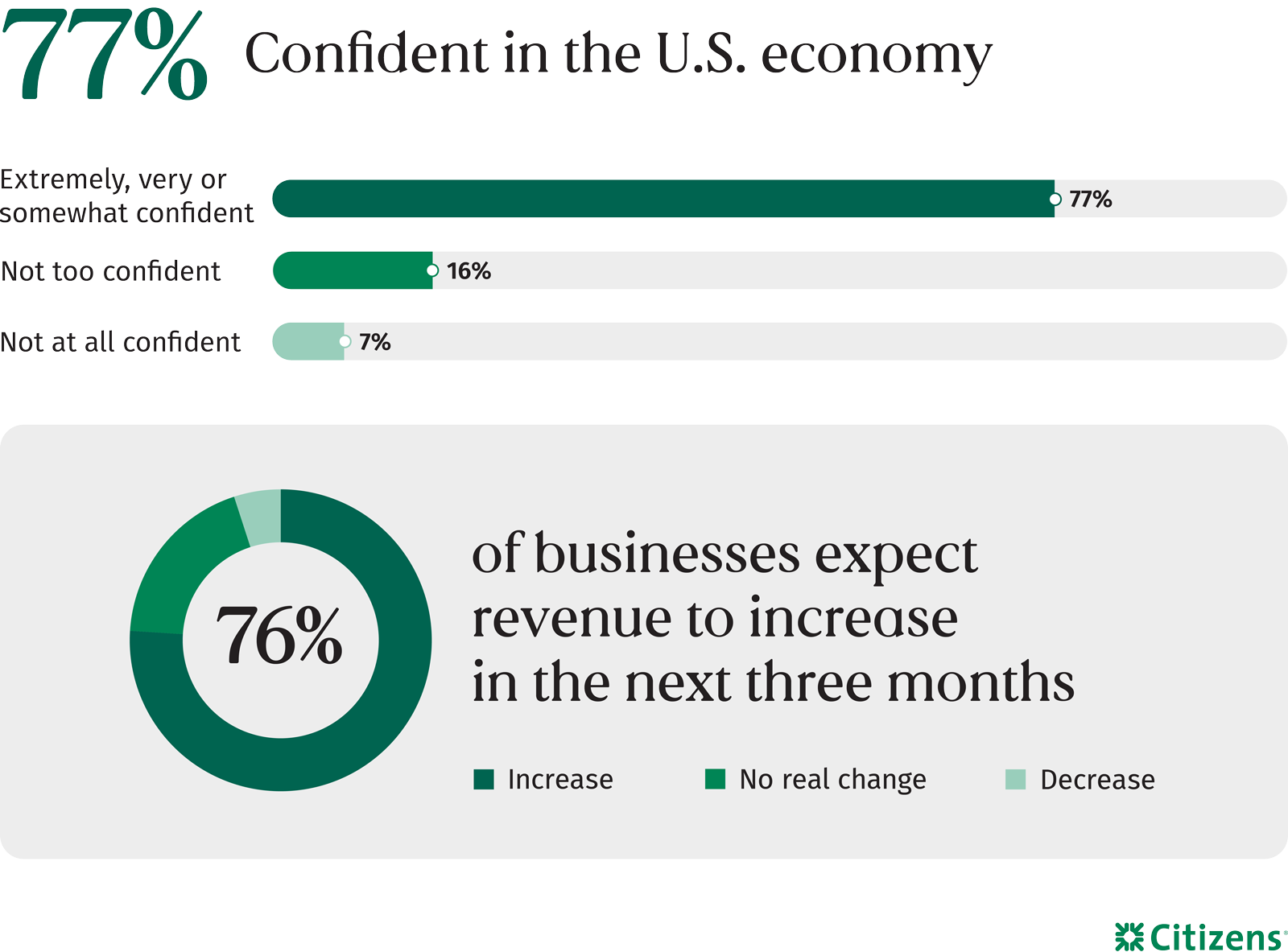
New research from Citizens finds that U.S. business leaders remain confident in their prospects and in the broader economy despite ongoing economic volatility. Sixty-seven percent of businesses with at least $500K in annual revenue expect revenue to rise in the first quarter. Nearly eight in 10 of these small and midsize firms are bullish on the overall economic outlook.
Leaders acknowledge economic headwinds and intense competition. Even so, they plan to grow by focusing relentlessly on customer needs and delivering more efficiently. Technology and talent will play a central role in this effort. Technology is the top spending priority across the small and midsize market, and roughly two-thirds of firms plan to hire. Many are making time for succession planning to future-proof what they've built.
This report examines outlook, revenue expectations, business challenges, investment priorities, staffing and succession planning. The findings draw from a survey of 500 founders, CEOs, partners, presidents and principals at U.S. companies. The analysis focuses on small and midsize businesses generating $500K to $100M+ in annual revenue.*
Q1 ambition and optimism in a turbulent economy
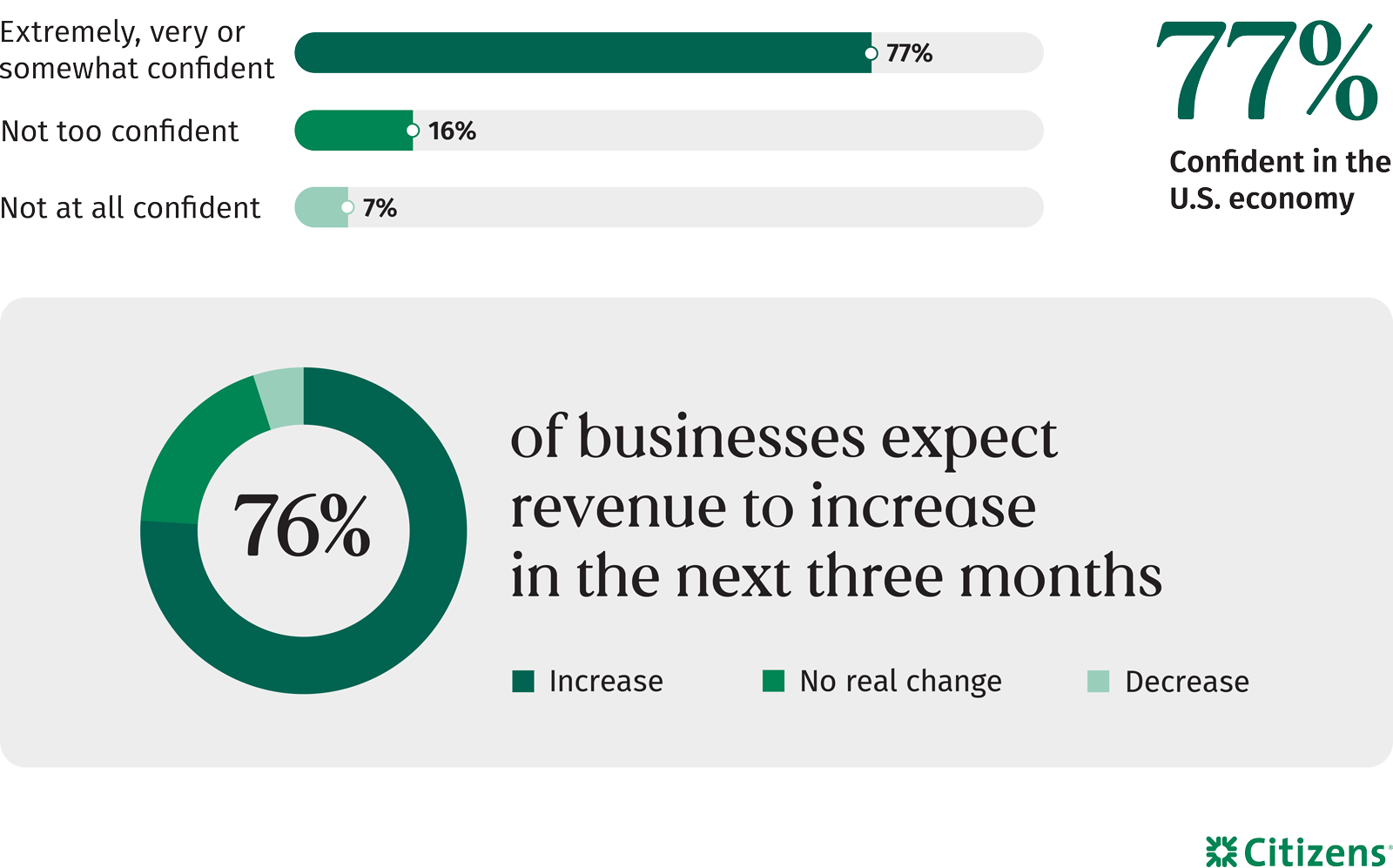
Business leaders are clear-eyed about high costs, economic uncertainty and intense competition. They acknowledge that these conditions make winning and retaining customers more difficult and put pressure on revenue growth. Even so, optimism is high going into 2026. Three-quarters of business owners expect revenue to increase and view the U.S. economy as healthy in the first quarter. Confidence levels are consistently high across the country with minimal regional variation.
Confidence in the U.S. economy over the next three months
Top 5 Q1 business challenges
- Managing rising costs/inflation
- Managing the impact of tariffs
- Coping with uncertainty about the economy
- Finding and keeping customers
- Finding and integrating technology
Tariffs are creating headwinds for small and midsize businesses across the country; 41% consider them a "major challenge." Close to 60% of U.S. businesses say tariffs have increased or will increase operating costs.
To offset the associated costs, half will pass on costs to customers, and 46% will adjust their supply chain.**
Inflation is another top struggle heading into 2026. Businesses are adjusting in the following ways:***
Top ways businesses respond to inflation
- Raising prices
- Absorbing cost increases
- Switching to lower-cost supplies
"Despite challenging economic conditions, business leaders are planning for success and charting a clear path forward in Q1. In true entrepreneurial style, they are combining creativity, resilience and determination with the right tools to deliver what customers want."
Mark Valentino
Head of Business Banking
Efficiency and technology investments drive Q1 results
How will business leaders achieve ambitious goals and sustain optimism in today's economy? Two-thirds say growth will come from expanding their customer base and improving efficiency. The survey shows a strong focus on doing more with less. Leaders are sharpening operations and investing in efficiency. They are also prioritizing what attracts customers and keeps them loyal.
Top reasons revenue will increase in Q1
- More customers 65%
- Improved efficiency & systems 60%
- New product and services offerings 55%
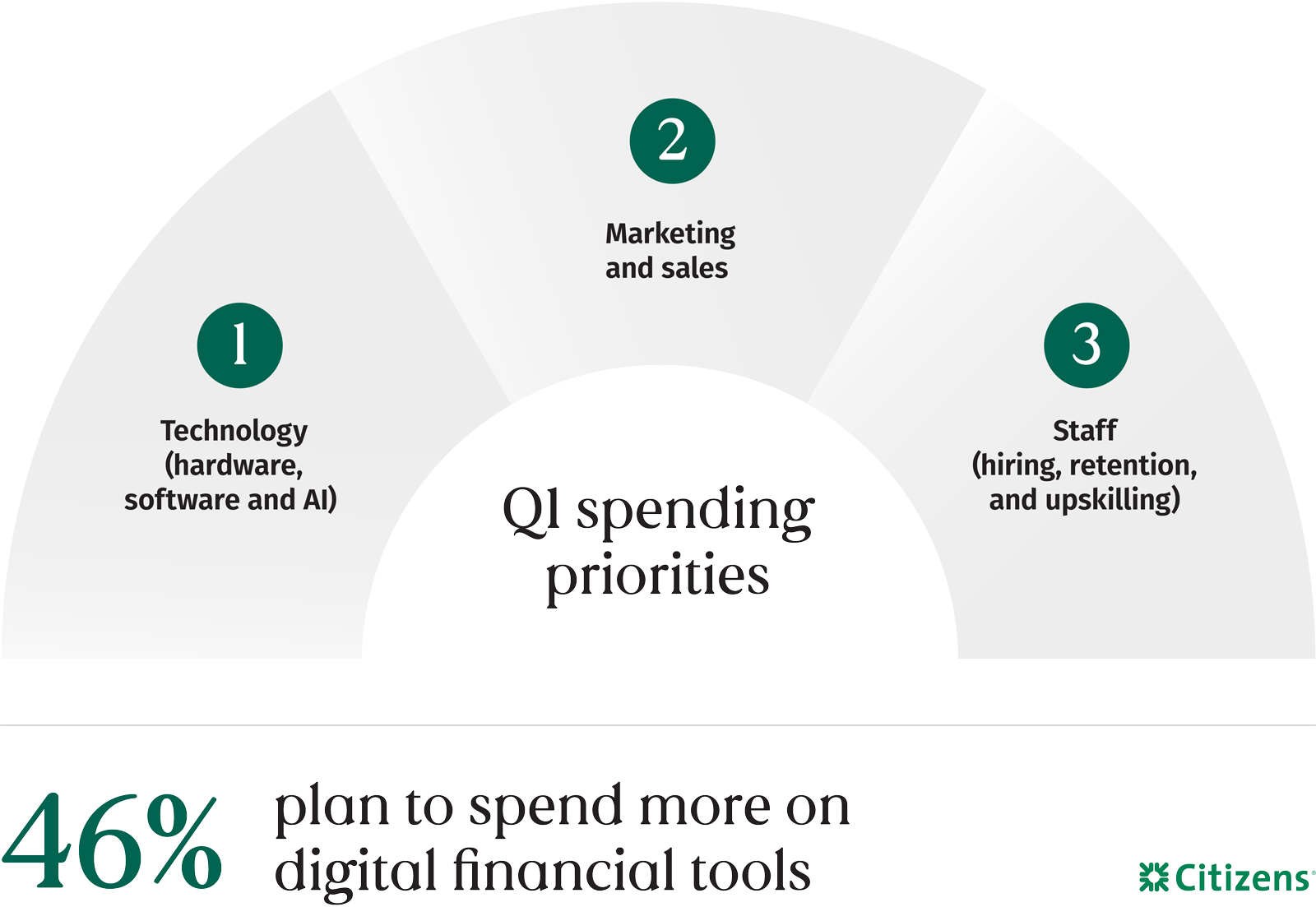
Spending tells the story of how leaders will reach Q1 revenue goals. Technology is the #1 spending priority for all small and midsize businesses. It's also important to examine what is motivating spending and optimization, and the survey finds efficiency, customer satisfaction and resource management are top motivators. It's clear that the most successful companies have determined how to use the right tools. Looking at how they are optimizing for success is instructive.
Q1 spending priorities
Top-performing companies understand the connection between technology, efficiency, and meeting customer demand. Companies anticipating fast growth (a revenue increase of 10% or more) are more focused on these priorities than other companies.
50% of fast growth companies cite meeting customer demand as a spending motivator, compared to 36% of other companies.
64% of fast growth companies will focus on technology spending in the next three months, vs. 42% of other business leaders with that focus.
51% of fast growers are spending more over the next three months on employee productivity, compared with 40% of other companies
51% cite "better digital financial tools" as a reason for anticipated revenue increases, vs. 31% of other businesses.
AI has a role to play in optimization and attaining goals. Among U.S. businesses, top AI uses are for efficiency and customer acquisition.**** For more on AI trends in financial management and how CFOs are using AI for payments and fraud detection; explore our AI Trends Report.
How U.S. businesses currently use AI
- Web, social, and digital analytics
- Business intelligence/data analytics
- Product development
"Q1 business leader plans demonstrate that they understand the impact of investing in the right tools to propel them toward important ambitious goals. With increased company and team efficiency, a business can focus on the customer, which is where growth potential ultimately lies."
Meline Gasparyan
Head of Business Banking Treasury Solutions
Staffing: A central priority for Q1 plans
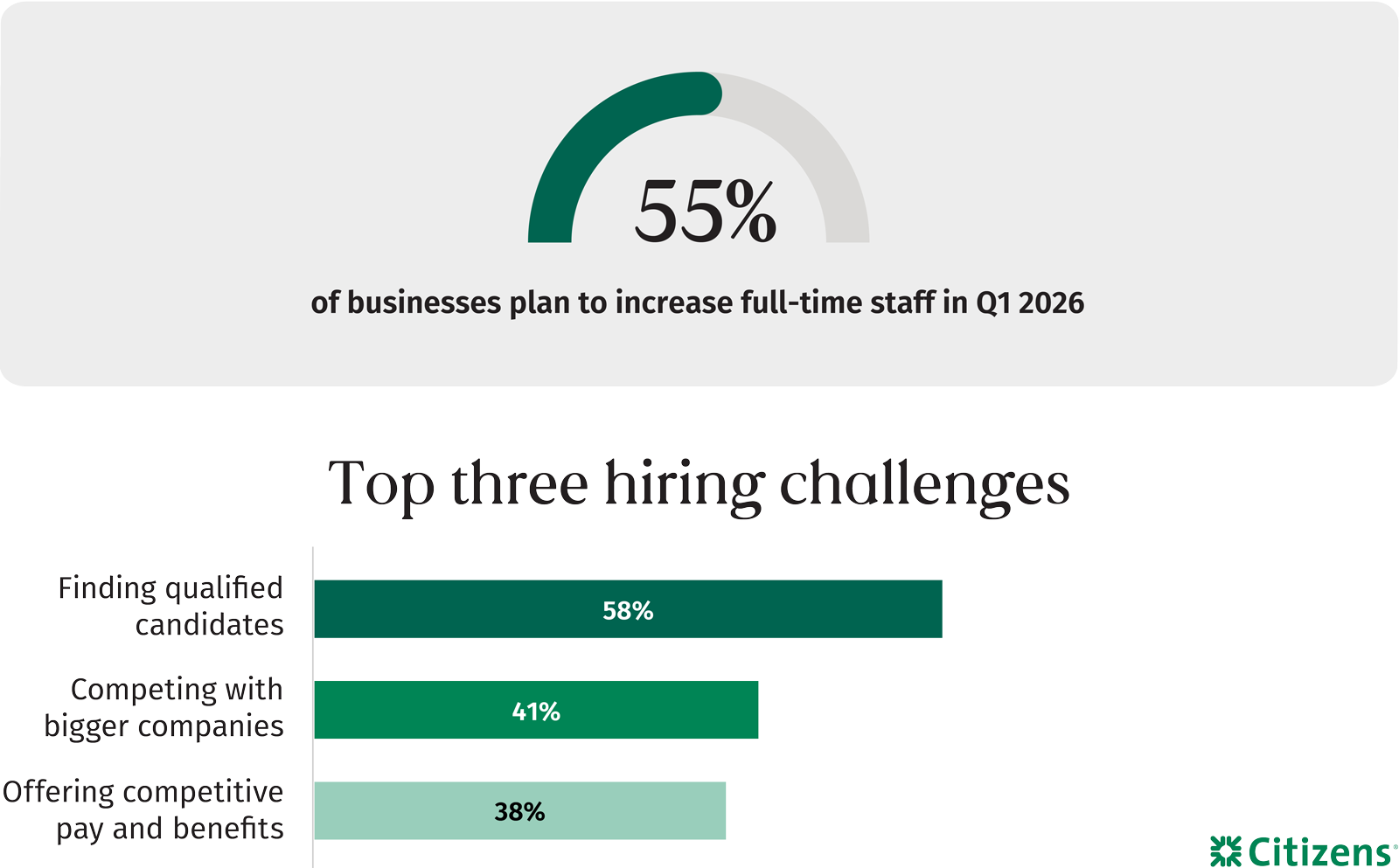
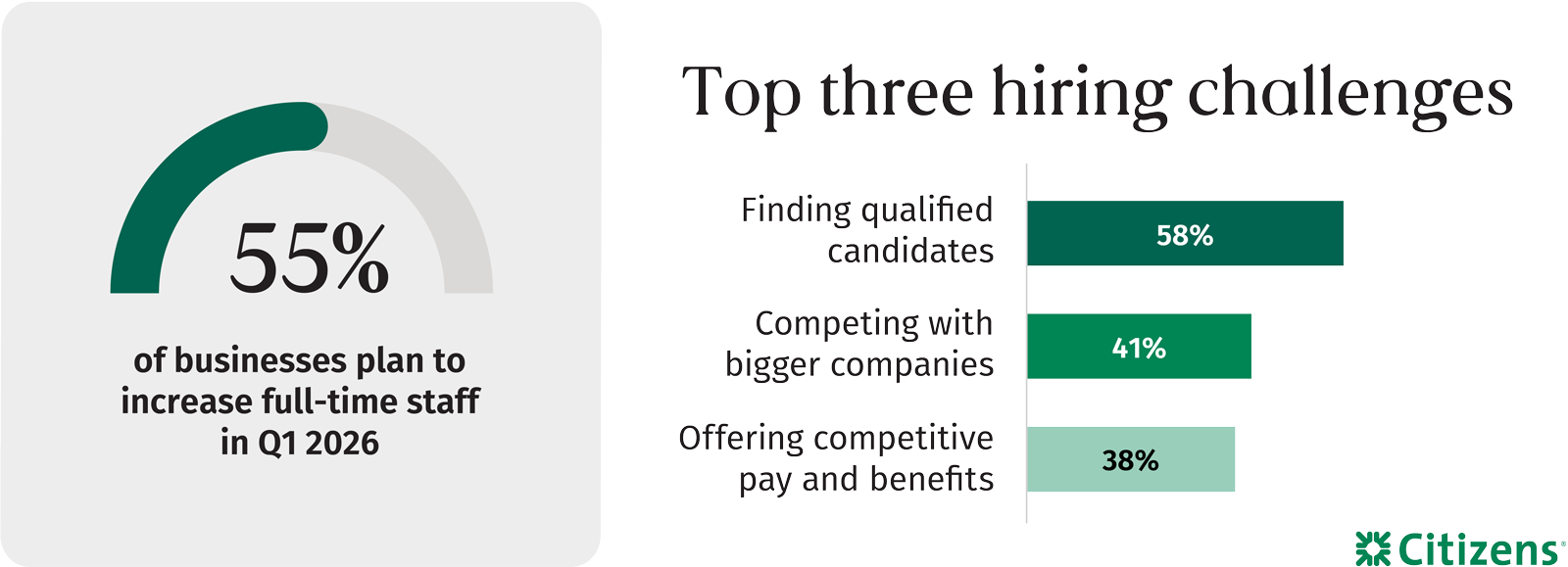
The Citizens survey reveals that business leaders understand the importance of maintaining and building strong teams. Staffing is a focus for Q1; 68% of companies say they'll hire this quarter. Small and midsize companies typically struggle to find, attract and integrate talent, and they anticipate these challenges for Q1. Fifty-five percent of businesses with $500K+ in revenue expect to increase their full-time headcount over the next quarter, with 66% of those with 100-1,000 employees expecting a full-time headcount increase.
Small and midsize companies are committed to finding candidates with the skills and experience needed to support Q1 goals. It's always difficult for businesses to find top talent, and the survey shows that this remains true. Business leaders also say they'll battle to provide competitive compensation and manage the hiring process.
Top hiring challenges
- Finding qualified candidates 58%
- Competing with bigger companies 41%
- Offering competitive pay & benefits 38%
- Managing the interview and hiring process 36%
- Onboarding and training new employees 35%
Business credit supports Q1 momentum
Ambitious Q1 goals and the reality of challenging conditions means businesses need to move quickly to seize opportunities and outpace competition. Credit will help support business Q1 plans, according to the survey.
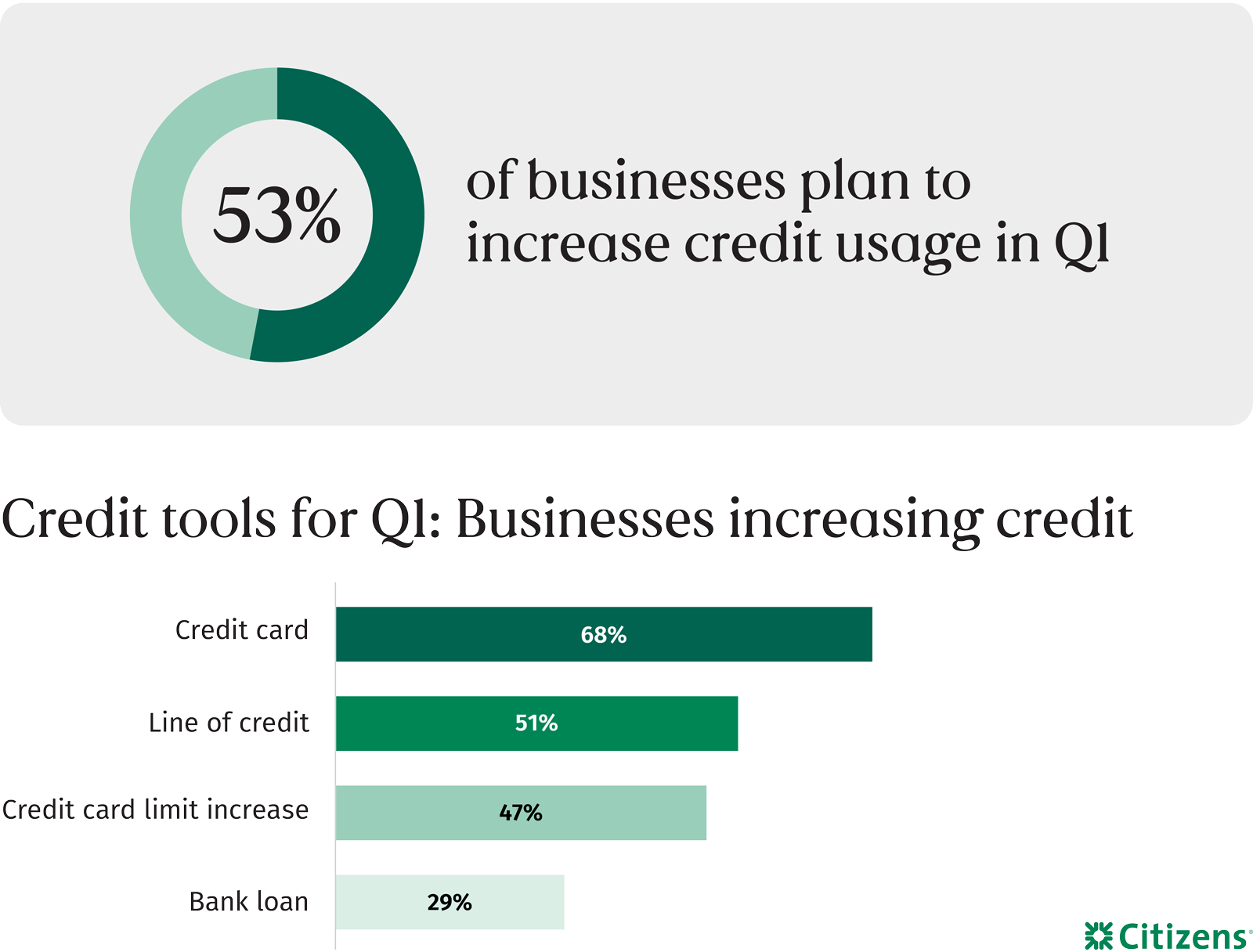
When asked about their plans to use business credit — credit cards, lines of credit, loans, etc. — 53% plan to increase their credit usage in Q1, while 43% plan to maintain their usage. The fastest-growing companies expecting 10% growth or more in Q1 are making use of their business credit at a much higher rate of 60%, compared to only 28% of companies expecting less growth. When looking at company size, 67% of businesses with 100-1000 employees will increase their credit usage, compared to 39% of businesses with less than 100 employees.
For businesses planning to increase credit use, top financial tools for Q1 include:
- Business credit card 68%
- Business line of credit 51%
- Business credit card Limit increase 47%
"A business line of credit has been a great security blanket; as a small business, I know that I need to be careful with money, but I also need to be comfortable with taking risks, so I can grow with support to keep moving in the right direction."
Ian Duryea
Duryea Electric
Planning now to lock in future success
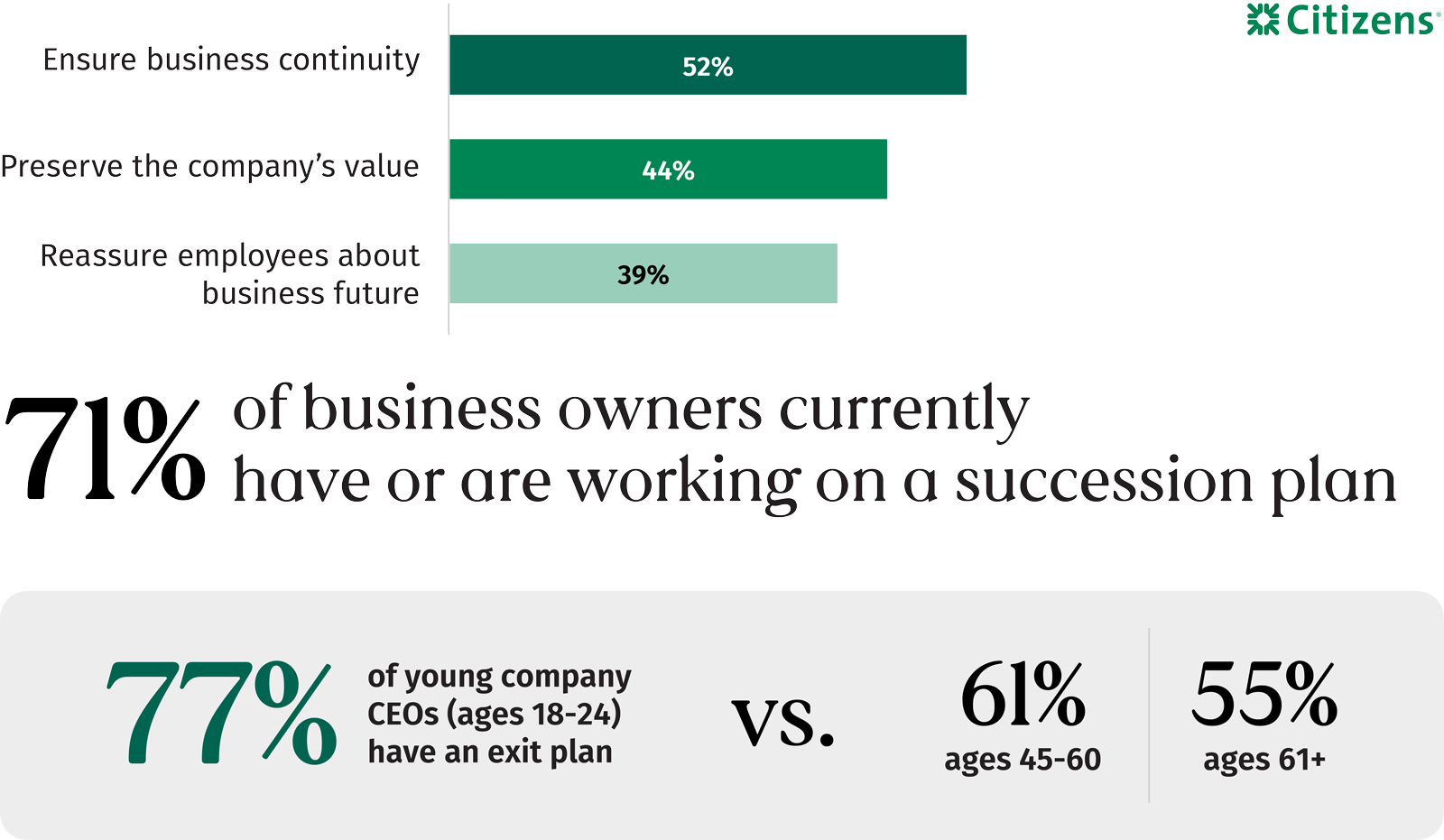
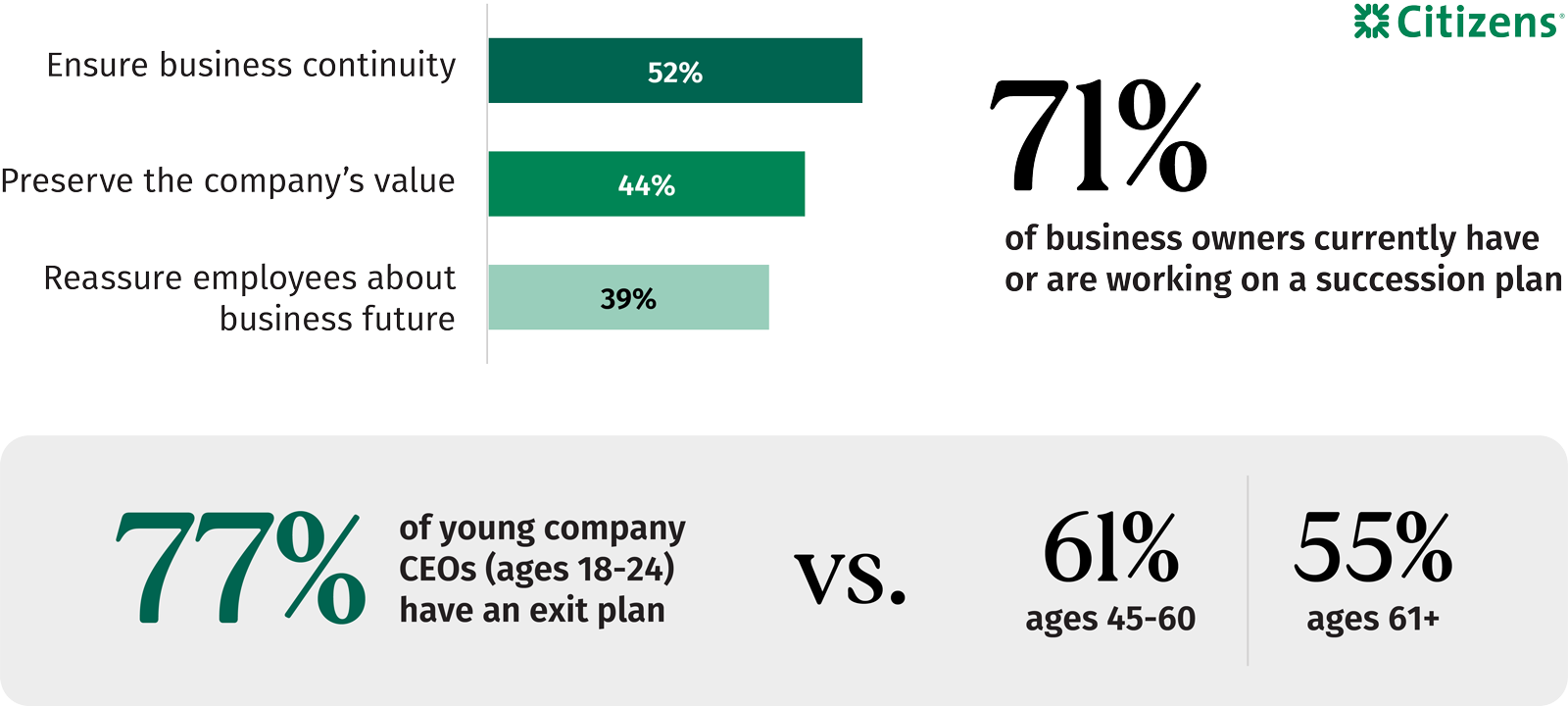
When small and midsize businesses were asked if they expect to transfer their business, 50% said they do plan to transfer at some point. Seventy-one percent have or are working on a succession plan, a process that maps out transition of leadership, resources and knowledge to protect company viability.
Survey data reveals that business leaders recognize that planning is needed to maintain business success when they are ready to hand over management.
Top 3 reasons businesses are committed to succession planning
- Ensure business continuity 52%
- Preserve the company's value 44%
- Reassure employees about business future 39%
Succession planning does not happen overnight, and the survey shows that many businesses, including some young business leaders, recognize this. The fastest-growing businesses are making time to plan for the future. They are involved in succession planning in larger numbers than other businesses. For businesses expecting 10% or more growth, 77% have a succession plan vs. only 54% for businesses expecting less growth in Q1.
Top reasons business are committed to succession planning
At Montville Florist, each generation has devoted itself to ensuring that important operational knowledge, commitment to customer satisfaction, and a connection to the community are carried forward.
"Eventually, I’d like to step back from the business a bit, and I'm confident [my daughter] will be more than ready to take over when the time comes."
Leah Van Ness
Montville Florist
Key takeaways: Q1 is time to optimize and outpace
New research from Citizens shows that in the midst of a shifting economic landscape, small and midsize companies are optimistic, forward thinking and grounded in economic reality. For Q1 2026, business leaders are:
Optimistic. Roughly three-quarters expect revenue increases soon and believe in the strength of the U.S. economy.
Customer focused. 65% of companies cite more customers as the reason revenues will increase in Q1.
Optimized for efficiency. 60% of businesses cite improved efficiency or systems as the way they’ll achieve Q1 revenue goals.
Technology enabled. Technology investments are a #1 priority, and AI will help with efficiency and customer acquisition and retention.
Leaning on tools. 53% of companies will use more credit to reach business goals in Q1; 46% plan to increase spending on digital financial tools.
Planning for succession: Business leaders of all ages and in all industries are planning ahead to protect what they’ve built when it’s time to hand off management of the company to others.
Click below to download the Executive Summary and/or the Full Data Report as a pdf.
Ready to turn these takeaways into action? Get in touch with our team.
Get in touch with our team. All fields are required unless marked as "Optional".
Please note: Citizens Business Banking Products and Services are offered in the following states: Connecticut, Delaware, Florida, Maryland, Massachusetts, Michigan, New Hampshire, New Jersey, New York, Ohio, Pennsylvania, Rhode Island, Vermont, Virginia and Washington, D.C.
© Citizens Financial Group, Inc. All rights reserved. Citizens Bank, N.A. Member FDIC
* Data is from an online survey of 500 principals (Owner, Founder, Partner, CEO, President, etc.) of U.S.-based businesses with up to 1,000 employees. The survey was conducted by market research company Bredin from November 1 through November 18, 2025. This report focuses on unweighted data from 304 respondents with $500,000+ in revenue.
** An online survey of 500 SMB principals at U.S. companies with 1-1000 employees fielded October 21-November 8, 2025, conducted by Bredin.
*** An online survey of 500 SMB principals at U.S. companies with 1-500 employees fielded August 20-September 2, 2025, conducted by Bredin.
**** An online survey of 500 SMB principals at U.S. companies with 1-1000 employees fielded June 2-18, 2025, conducted by Bredin