
What is compounding interest?
Key takeaways
- Compounding interest allows you to earn interest on your entire account balance, including the prior interest earned.
- The longer you allow a balance to compound, the greater your earnings when compared to non-compounding balances.
- Compounding interest can help you achieve your savings goals faster.
Interest rate calculations are not always determined in a straightforward manner — hence the fine print you may notice in your account's terms and conditions. Although it can take some time to run through different interest rate options, understanding how compound interest works helps you to make better choices when saving and investing. Compound interest calculations may also factor into your decision to pay off a loan or credit card balance faster.
What is compounding interest?
Compounded interest calculations essentially allow you to earn interest on your entire account balance, including prior interest earned. For example, if you place $100 in an account with an annual compound interest rate of 5%, at the end of the year your balance will grow to $105, including accumulated interest. For year two of compounding, interest will be calculated on this new account balance of $105, rather than the original $100.
Accounts with compound interest earn what's known as an annual percentage yield (APY), rather than an annual percentage rate (APR). Compound interest may be offered in a variety of savings accounts, investments and certificates of deposit.
On the flip side, compounding interest can increase the repayment amount for some types of loans. Most credit card companies use a compounding calculation for interest owed on revolving balances.
Interest may compound at any pre-determined frequency, from as little as one day, up to a year. This frequency will determine the amount of interest you earn on an account, as smaller compounding periods such as weeks or months lead to faster balance growth than annual compounding.
Pros and cons of compounding interest
When choosing a savings or investment account, you'll want to look at each of the characteristics or terms of an account, including compounding interest. Weigh the pros and cons of each option to determine what works best for you.
Some of the pros of compounding to consider include:
- Savings and investment balances grow faster over time when interest is compounded.
- A lower initial investment may be needed to reach your savings goals.
- Typically, no further action is required to continue compounding as long as your money remains in the account.
- The final interest amount you'll earn will be greater than the simple interest earnings calculated only on your principal balance.
Some cons of compounding interest may include the following:
- The calculation is more complex than the simple interest method which can make it more difficult to determine exactly how much you'll earn over an extended time period.
- You'll pay more in interest for revolving balances on loans and credit cards that charge compound interest.
- The effect of compounding may not make much of a difference in your total earnings if you're only saving or investing for a short time period.
Also, it's important to note that some accounts, like money market accounts, may offer compounding interest, but at a variable rate. This means that your APY could fluctuate, although you will still realize the benefits of compounding.
Benefits of compounding interest
What is compounding interest's greatest benefit? You gain the ability to earn interest on a higher amount and build the balances in your savings accounts or investments. Compounded earnings tend to be exponential, in that your balance grows at a greater rate each year. As interest earnings add to your compounding basis, you'll place yourself further and further ahead compared to accounts earning a simple interest rate return. This means you can make a lower initial investment to meet future savings goals and rely on interest earnings to make up the difference over time.
How is compounding interest calculated?
To calculate compound interest, you need four variables into the following equation:
Future value including compound interest = P(1+r/n)nt
P = Principal amount
r = Interest rate (expressed as a decimal point)
n = Number of compounding periods in one year (monthly would = 12)
t = Number of years' worth of compounded interest you want to calculate
Fortunately, you don't have to calculate this number by hand. You can utilize an online financial calculator or a spreadsheet to change the inputs in the compound interest formula. This will help to illustrate the effects of different interest rates or time horizons on your earnings.
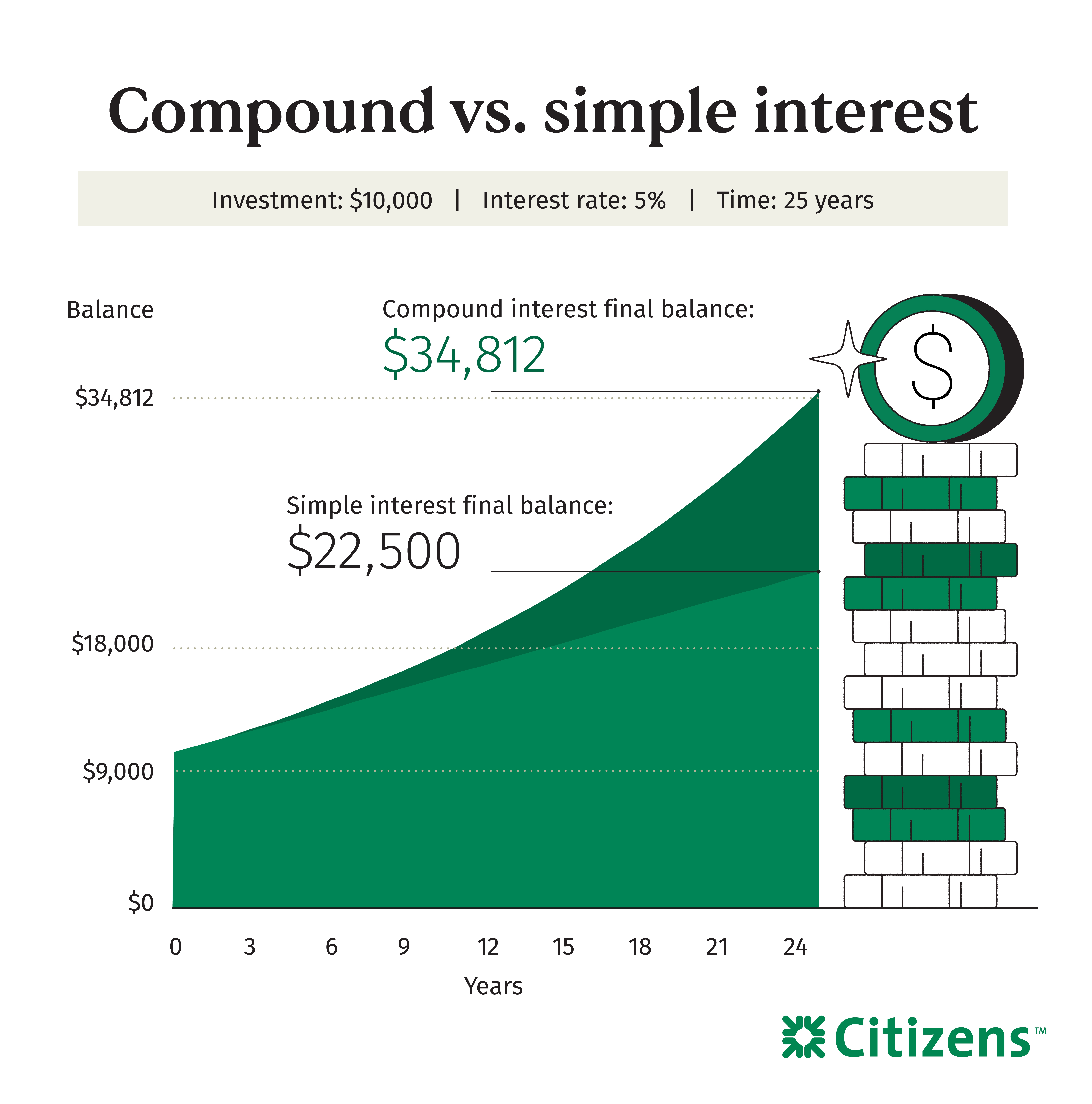
Compounding interest vs. simple interest
Although you may notice only small increases in compounded versus simple interest account balances over a relatively short period, such as one or two years, the true power of compounding becomes evident when investing for the long term. How much more can you earn with compounding interest?
Investing $1,000 at a 5% interest rate, compounding monthly, will yield you a balance of $1,104.94 in two years, compared with a balance of $1,100 when earning simple interest. But extending the time to thirty years yields a more significant difference: $4,467 including compounded earnings versus $2,500 with simple interest. In fact, using the same $1,000 initial balance, compounded earnings will result in a balance of $2,712.64 in 20 years, meaning that you'll make more money in less time compared to simple interest earnings.
Start earning interest with a savings account
The power of compounding interest allows savers to earn more on their balances in a shorter timeframe. Now that you know more about this all-important interest calculation, you can start to make smarter financial decisions when choosing how to save or invest your hard-earned dollars.
Looking to build your savings? Citizens offers a variety of account options.

Top 5 money saving tips to help you save
Follow these tips and tricks to enhance your savings strategies.

How to start an emergency fund
Add a financial cushion to help you deal with life's unexpected events.

How to save money fast
Need money fast? Make changes today to help you save.
© Citizens Financial Group, Inc. All rights reserved. Citizens Bank, N.A. Member FDIC
Disclaimer: The information contained herein is for informational purposes only as a service to the public and is not legal advice or a substitute for legal counsel. You should do your own research and/or contact your own legal or tax advisor for assistance with questions you may have on the information contained herein.