
Fed Raises Rates, Reinforcing Warsh's Inflation Fight
By Richard Anderson, CFA, Senior Portfolio Strategist
Key takeaways
- The Fed raised rates by 25 basis points, marking its first increase since July 2023 and reinforcing Chair Kevin Warsh's focus on restoring price stability.
- Updated Fed projections now imply one additional rate hike this year and a longer pause before rate cuts begin.
- Inflation remains the key policy concern, while a stable labor market gives the Fed room to keep policy restrictive.
- Markets initially expected the move, but reacted negatively to Warsh's hawkish tone as investors reassessed the risk of a higher-for-longer rate environment.
- We view this as a risk management hike rather than the start of a major tightening cycle, leaving the backdrop constructive for diversified, multi-asset portfolios.
The Federal Reserve raised interest rates for the first time since July 2023, reinforcing Chair Kevin Warsh's commitment to restoring price stability. The decision was widely expected, but the updated policy projections delivered a more consequential message: interest rates may remain higher for longer than policymakers anticipated just three months ago.
"We at the Fed are unwavering in our vital and straightforward purpose: full employment and price stability, and a thriving American economy that sets the standard for the world." - Kevin Warsh
We view the move as a risk management hike rather than the start of a prolonged tightening cycle. Inflation remains too high for the Fed to ignore, but much of the pressure still reflects supply-side forces that should ease over time. For investors, this distinction matters because a shorter, shallower rate cycle would remain manageable for diversified portfolios.
A Unanimous Decision to Hike Rates
At its September 16 meeting, the Federal Open Market Committee (FOMC) unanimously raised the federal funds target range by 0.25% to 3.75%–4.00%. The increase marked the Fed's first rate hike in more than three years and ended a streak of five consecutive meetings without a change in rates.
The 12–0 vote also represented a shift from the Fed's divided July meeting. Three policymakers dissented at that meeting in favor of an immediate 25 basis point increase, highlighting growing concern that inflation could remain above target. This time, stronger labor data and persistent inflation brought the Committee together.
The unanimous vote reinforces the Fed's inflation-fighting credibility. It also suggests the debate has shifted from whether policy needed to tighten to how much additional restraint will be required.
Policymakers Signal One More Hike
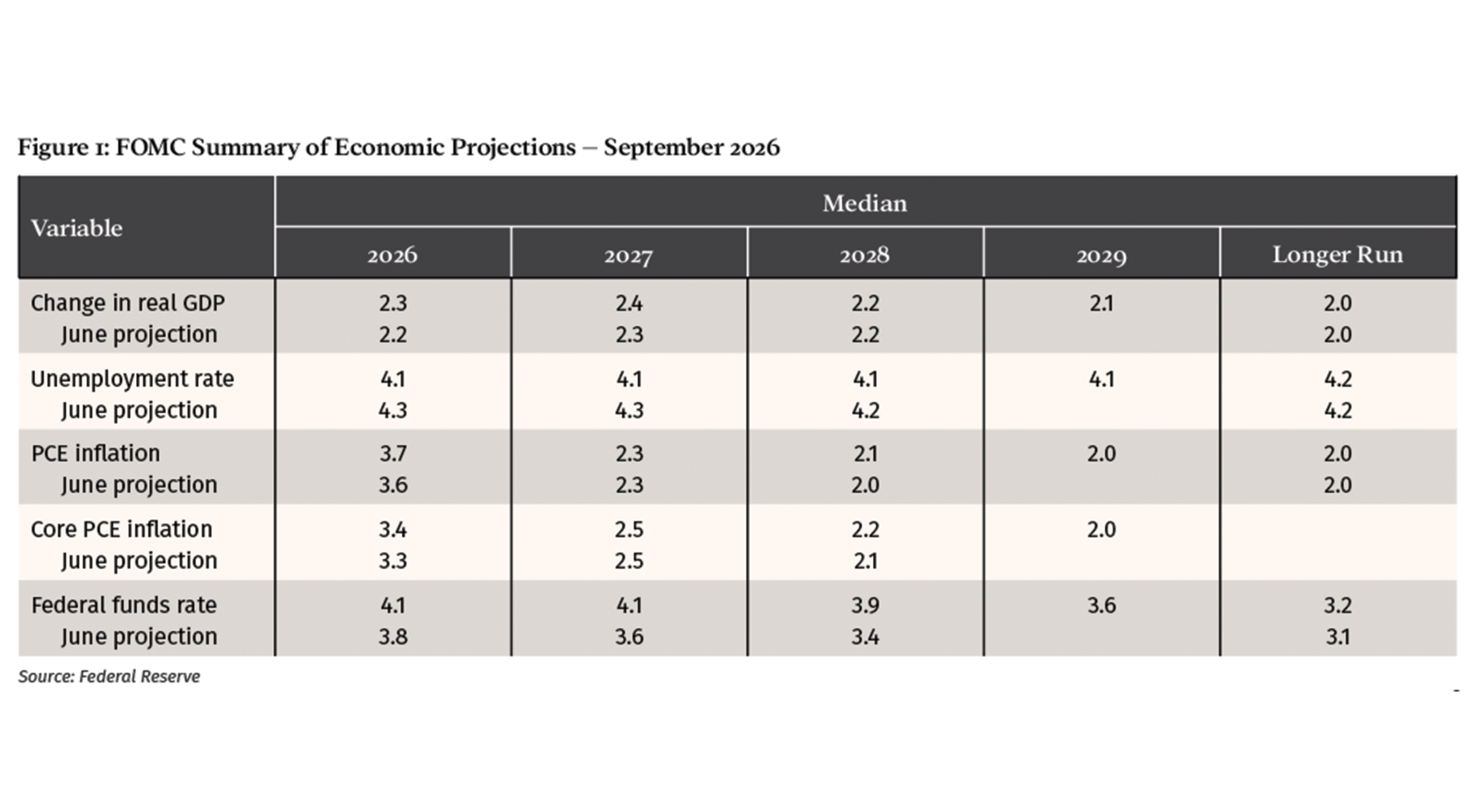
The Fed's updated Summary of Economic Projections, shown as Figure 1 below, pointed to a stronger economy, lower unemployment, and a higher path for interest rates. For 2026, policymakers raised their median estimate for real GDP growth to 2.3% from 2.2%, lowered the projected unemployment rate to 4.1% from 4.3%, and increased their headline PCE inflation forecast to 3.7% from 3.6%.
The largest change was in the projected path of monetary policy. The median policymaker now expects the federal funds rate to end 2026 at 4.1%, up from the 3.8% estimate published in June. That projection implies one additional 25 basis point increase before year-end.
The outlook beyond 2026 also moved higher. Policymakers raised their median rate estimate for the end of 2027 to 4.1% from 3.6% and their 2028 estimate to 3.9% from 3.4%. In June, the Committee expected one hike in 2026 followed by rate cuts in 2027. The September projections instead suggest another hike this year and no reduction until 2028.
The agreement is strongest around the near-term outlook. Twelve policymakers project a 4.1% rate at the end of 2026, while four expect a higher rate and two expect a lower one. The 2027 projections are more dispersed: six officials remain at 4.1%, eight are above that level, and four are below it. One policymaker expects the rate to fall as low as 3.1%.
That dispersion underscores an important point. The Fed has established its near-term direction, but the duration of tighter policy remains unsettled.
Inflation Was the Deciding Variable
The economic data since July gave the Fed room to focus squarely on inflation. July payroll growth disappointed, but hiring rebounded sharply in August and prior months were revised higher. The unemployment rate remained steady, initial unemployment claims stayed low, and wage growth remained contained.
Together, these indicators describe a labor market that is neither overheating nor deteriorating. That balance removed employment as an immediate constraint on Fed policy and left inflation as the deciding variable.
Inflation has not improved fast enough to satisfy policymakers. Headline CPI rose 3.4% over the 12 months through August, matching its July pace. Headline PCE inflation increased 3.7% over the 12 months through July, unchanged from June.
Energy prices have contributed to the elevated readings as the war in Iran continues to affect global energy markets. Yet core inflation has also remained sticky. Core CPI increased 2.4% through August after rising 2.5% in July, while core PCE inflation held at 3.3% in both June and July.
Warsh outlined the Fed's test at the Jackson Hole Economic Symposium in August. The Committee needed confidence that underlying inflation was moving clearly toward 2% at a sufficient pace. The incoming data did not meet that test, making a September hike difficult to avoid.
The Fed Protects its Credibility
The decision was also about credibility. Fed officials spent much of the summer signaling concern about inflation persistence. Once labor market risks faded, standing pat would have been increasingly difficult to justify.
In the days leading up to the September FOMC meeting, fed funds futures assigned more than a 90% probability to a rate increase. A second consecutive hold could have cast further doubt on the Fed's willingness to act, especially after Warsh's hawkish Jackson Hole remarks.
The Fed therefore faced pressure from both the data and its own communication. Inflation remained above target, the labor market was stable, and the Committee had clearly laid out the conditions for tighter policy. Once those conditions were met, failing to act would have weakened the message.
The hike restores some of that credibility. That said, credibility does not require the Fed to follow a predetermined series of increases. It requires policymakers to respond consistently as inflation, employment, and financial conditions evolve.
Markets Reprice the Path of Policy
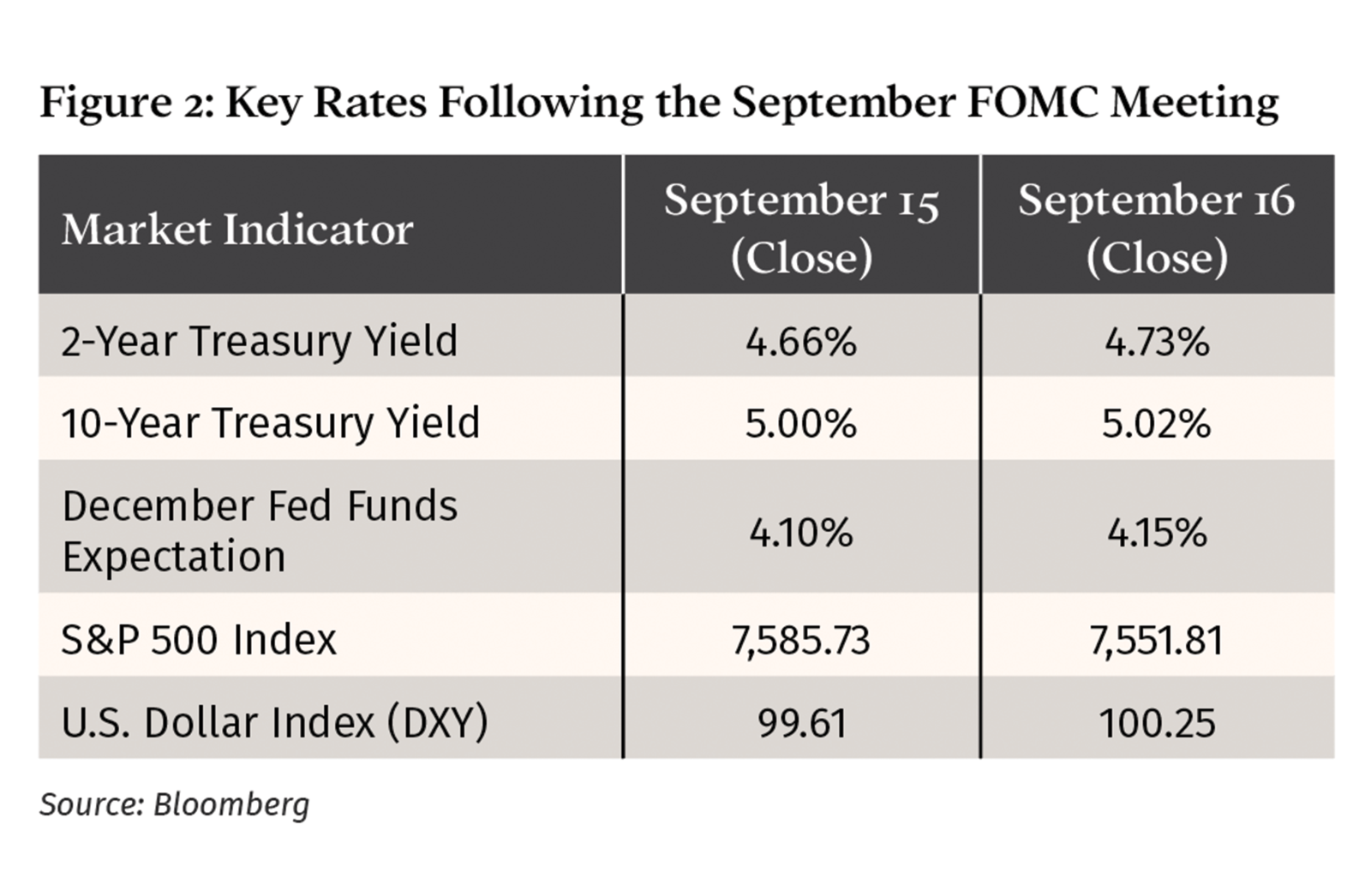
Financial markets initially reacted modestly to the Fed's widely anticipated 25 basis point rate hike. Treasury yields were little changed and equity markets were broadly stable following the release of the FOMC statement, suggesting the decision itself was largely priced into markets.
The tone shifted during Chair Kevin Warsh's press conference. His comments reinforced the Fed's commitment to returning inflation to its 2% target and signaled a willingness to maintain restrictive policy if inflation fails to moderate sufficiently. Following his remarks, Treasury yields moved higher, equity indices retreated, and the U.S. dollar strengthened as investors reassessed the likelihood of additional rate hikes and a higher for longer interest rate environment.
Investors are increasingly focused on what comes next. Markets are assigning a greater than 50% probability to another hike at the October 28 meeting and a near 90% probability to an increase at the December 9 meeting. Futures imply a year-end federal funds rate near 4.15%, broadly consistent with the Fed's median projection for one additional hike.
A Shorter and Shallower Cycle
History suggests that an initial rate hike is often followed by at least one more. The stable labor market has lowered the bar for another move because policymakers can tighten without creating an immediate conflict with the employment side of their mandate. For now, a second increase later this year is a reasonable base case.
We are less convinced that the Fed will deliver the amount of tightening markets expect through 2027. Three forces have contributed to the inflation shock: tariffs, higher energy prices, and spending associated with the artificial intelligence buildout. AI-related demand may prove persistent, but the effects of tariffs and energy disruptions should fade if geopolitical conditions stabilize.
Scheduled revisions to the PCE inflation methodology could also lower reported inflation by an estimated 20 to 30 basis points. Those changes would not alter consumer prices directly, but they could improve the inflation data used by the Fed to assess progress toward its target.
We therefore interpret the September decision as a risk management hike designed to reinforce policy credibility. Chair Warsh and other officials could only emphasize their inflation commitment for so long before action became necessary. A credibility-focused move would likely produce a shorter and shallower cycle than one aimed at suppressing broad, demand-driven inflation.
Market pricing above 4.1% at the end of 2026 and near 4.5% at the end of 2027 appears aggressive under that scenario. This Fed has emphasized data dependence, suggesting policymakers will move cautiously rather than commit in advance to an extended series of hikes.
What Would Change Our View?
Our outlook rests on the judgment that much of the recent inflation pressure is supply driven. Supply shocks can be painful, but they typically fade rather than compound indefinitely.
We would reassess that view if inflation began spreading more broadly through the economy. A renewed escalation in tariffs or Middle East hostilities could keep goods and energy prices elevated. More accommodative fiscal policy could also strengthen demand and create a more persistent form of inflation.
The key transmission channel is whether higher energy costs pass through to core goods and core services excluding shelter. That would signal that the energy shock had developed into a broader monetary policy problem and could justify a longer tightening cycle.
A material reacceleration in the labor market would present a similar challenge. Stronger job creation combined with above-trend wage growth would increase the risk that demand is adding to inflation. Either development would put pressure on the Fed to raise rates further and challenge our view that current market pricing is too aggressive.
Investment Implications and Portfolio Positioning
The bond market moved ahead of the Fed. Treasury yields shifted meaningfully higher in the weeks before the meeting, while the yield curve flattened modestly. Short-term yields responded to expectations for tighter Fed policy, while long-term yields reflected inflation, economic growth, and concern about the expanding federal deficit.
We maintain a neutral view of fixed income. Higher starting yields provide more income and a larger buffer against additional rate increases. We would avoid excessive duration exposure, but extending beyond cash remains attractive for investors seeking to lock in higher yields.
Corporate credit spreads remain tight, limiting the room for further price appreciation. However, corporate balance sheets remain healthy, and many issuers appear capable of managing higher borrowing costs. We continue to favor quality and security selection over broad exposure to the most rate-sensitive borrowers.
Our equity outlook also remains constructive. Earnings growth is running near multi-year highs, while share prices have not fully kept pace with earnings, allowing valuation multiples to compress. Economic growth remains near trend, supported in part by continued capital spending on AI infrastructure.
Higher rates can create pressure for companies that depend heavily on inexpensive financing. Investors should therefore favor businesses with durable earnings, strong free cash flow, and manageable debt loads.
Within a diversified portfolio, selectivity matters more than making a broad retreat or bet on any one particular asset class.
Bottom Line
The Fed's unanimous 25 basis point increase was in line with market expectations, but it sent a clear message about the Committee's inflation tolerance. Stronger employment data removed the labor market as an obstacle, while sticky core inflation and elevated energy prices shifted the balance of risks toward tighter policy.
Policymakers project one additional hike later this year, followed by an extended pause. We agree that another increase is possible, but we believe markets are pricing too much tightening over the coming year. Easing supply pressures and slower inflation should eventually allow the Fed to move to the sidelines.
This does not look like the start of another major tightening cycle. Higher yields may create near-term volatility, but they also improve expected returns for fixed income, while solid earnings continue to support equities. We believe the environment remains constructive for diversified, multi-asset portfolios.
© Citizens Financial Group, Inc. All rights reserved. Citizens Bank, N.A. Member FDIC
Past performance is not indicative of future results. All investments involve risk, including the possible loss of principal. Different investment products and strategies involve varying degrees of risk, and there can be no assurance that any investment, investment strategy, or recommendation made by Citizens Private Wealth ("CPW") will achieve its intended objective or match or exceed historical performance.
CPW's registration as an investment adviser does not imply any level of skill, training, or expertise, nor does it constitute an endorsement by any regulatory authority. The information provided herein is for informational purposes only, is of a general nature, and should not be construed as personalized investment advice or a recommendation to engage in any particular investment strategy. Additional information regarding CPW's advisory services, fees, risks, conflicts of interest, and other important disclosures is available in CPW's Form ADV Part 2A Brochure and Form CRS (Client Relationship Summary), which should be reviewed carefully before making any investment decision. Investors should consult their own legal, tax, and other professional advisors regarding the legal, tax, and financial consequences of any investment strategy discussed herein. CPW's registration as an investment adviser does not imply any level of skill, training, or expertise, nor does it constitute an endorsement by any regulatory authority. The information provided herein is for informational purposes only, is of a general nature, and should not be construed as personalized investment advice or a recommendation to engage in any particular investment strategy. Additional information regarding CPW's advisory services, fees, risks, conflicts of interest, and other important disclosures is available in CPW's Form ADV Part 2A Brochure and Form CRS (Client Relationship Summary), which should be reviewed carefully before making any investment decision. Investors should consult their own legal, tax, and other professional advisors regarding the legal, tax, and financial consequences of any investment strategy discussed herein.
The investment products and financial strategies suggested herein are subject to investment risk, including possible loss of principal amount invested. There can be no guarantee the suggested strategies or investments will lead to successful outcomes. Investment decisions should be based on each individual’s goals, time horizon and tolerance for risk.
Citizens Wealth Management (in certain instances d/b/a Citizens Private Wealth) is a division of Citizens Bank, N.A. ("Citizens"). Securities, insurance, brokerage services, and investment advisory services are offered by Citizens Securities, Inc. ("CSI"), a registered broker-dealer (Branch address: One Citizens Bank Way, Johnston RI 02919) and SEC registered investment adviser - Member FINRA/SIPC. Investment advisory services are also offered by Citizens Private Wealth, LLC ("CPW"), an SEC-registered investment adviser (see Form ADV Part 2A for details). CSI and CPW are affiliates of Citizens. Banking products and trust services are offered by Citizens. For deposit products, Member FDIC.
SECURITIES, INVESTMENTS AND INSURANCE PRODUCTS ARE SUBJECT TO RISK, INCLUDING PRINCIPAL AMOUNT INVESTED, AND ARE:
· NOT FDIC INSURED · NOT BANK GUARANTEED · NOT A DEPOSIT · NOT INSURED BY ANY FEDERAL GOVERNMENT AGENCY · MAY LOSE VALUE