
From Side Hustles to Strategy: Guiding the Next Generation of High-Net-Worth Clients

Key Takeaways
- Young adults are prioritizing stability, flexibility, and mental health over traditional markers of success.
- Entrepreneurial paths are creating lumpier, less linear, and more complex financial lives that require tailored planning.
- High-net-worth (HNW) individuals in this generation benefit from advisors who combine strategic guidance, mentorship, and education aligned with evolving values.
A new Citizens Next Gen: Future of Success Survey of over 2,300 young adults reveals a generation redefining the definition of success by prioritizing stability, flexibility, and mental health over prestige and accumulation. These findings reflect broader consumer patterns across income levels, but they carry particular weight for the next generation of HNW individuals and entrepreneurs.
This piece explores how these broader trends manifest uniquely among HNW young adults, and the unique financial planning considerations for young entrepreneurs.
Prioritizing Personal Trajectories over Corporate Scorecards
Corporate titles and tenure once defined success. But according to Citizens' Next Gen: Future of Success Survey, only 26% of young adults define career success as climbing the corporate ladder. For many in the next generation of high-net-worth individuals, wealth-building is increasingly entrepreneurial, values-driven, and shaped by the pursuit of flexibility and fulfillment.
This shift calls for an approach to financial planning that supports independent trajectories and prepares clients for the complexity of building wealth outside traditional structures.
Entrepreneurism and the Rise of the Independent Wealth Builder

Side hustles, startups, and independent ventures are becoming more common and more viable. In the Next Gen: Future of Success Survey, 24% of respondents reported having a side hustle, and more than two-thirds said they have pursued or are actively exploring an entrepreneurial venture.
This shift offers greater independence, ownership, and potential for accelerated wealth creation. But it also introduces planning complexity. Entrepreneurs may juggle multiple entities, equity stakes, and alternative assets, often without employer-sponsored benefits or traditional mentorship. Income can be irregular, often arriving in bursts.
For entrepreneurs, early-stage planning is critical. Structuring ventures, diversifying income streams, and preparing for uneven liquidity all require foresight and expertise. And the emotional factors of building wealth today should not be ignored. Entrepreneurism offers freedom, but it demands resilience. Planning must reflect that reality.
New Risks, New Realities: The Planning Implications
For high-net-worth clients pursuing independent business ventures, financial planning must be flexible, proactive, and deeply personalized. The following strategies can help address the most common challenges:
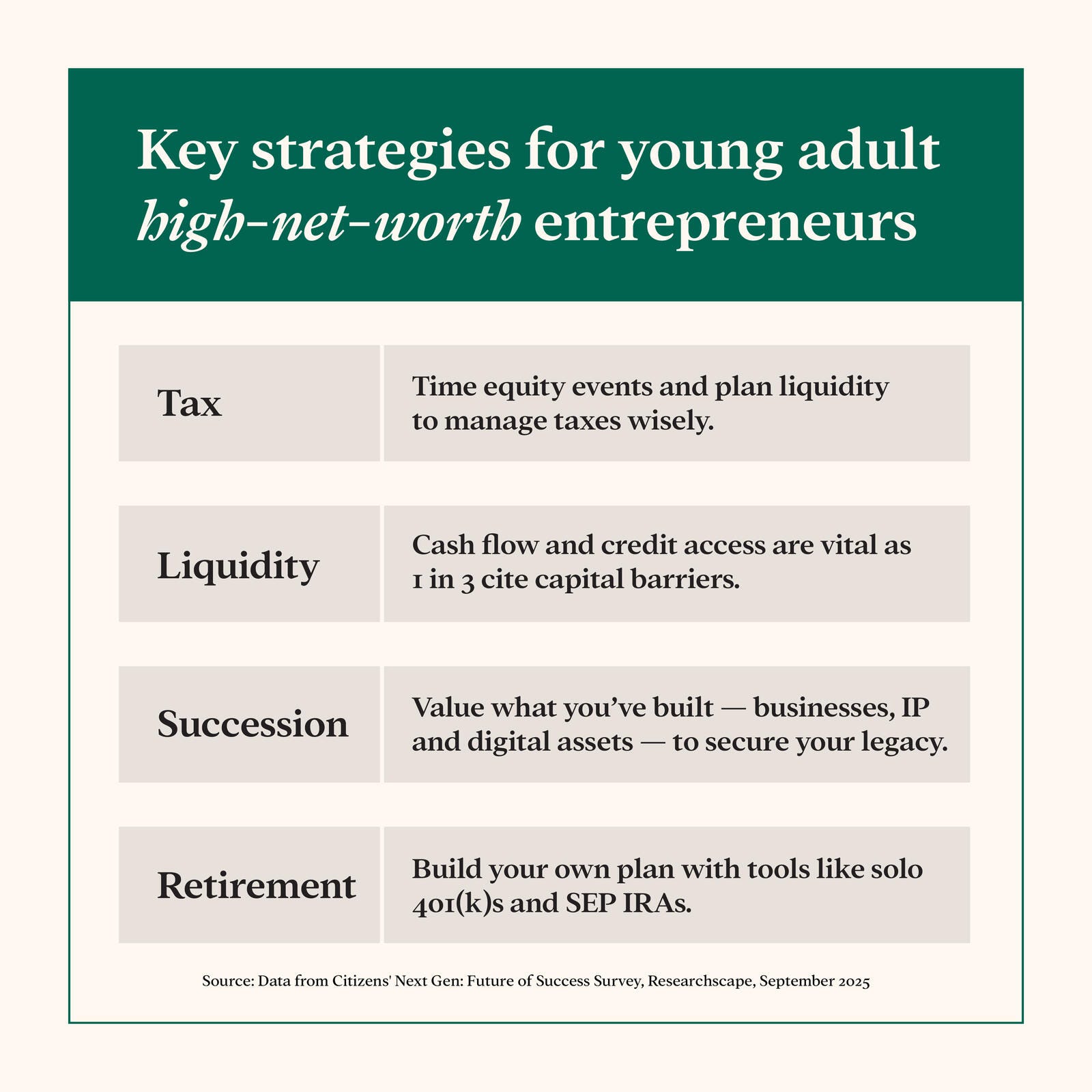
Tax Strategy: Entrepreneurs often face complex tax scenarios involving self-employment income, equity compensation, and capital gains. Some strategies that entrepreneurs may need to consider include:
- Timing equity events to optimize tax outcomes
- Accounting for capital gains exposure
- Understanding preferential tax treatment and liquidity planning for equity-based compensation, such as the potential benefits of Qualified Small Business Stock (QSBS) exclusions and the importance of meeting long-term capital gains holding periods for carried interest
- Accessing liquidity sources to cover unexpected tax obligations, particularly in cases where private equity funds generate taxable activity without corresponding distributions
Liquidity Management: Over one-third of Next Gen: Future of Success Survey respondents cited access to capital as a barrier to launching a business. Maintaining access to cash for personal needs, reinvestment, or emergencies becomes critical when young professionals forge their own path. Some tools entrepreneurs frequently rely on to manage liquidity include:
- Cash flow modeling across entities and income sources
- Credit solutions and reserve strategies to bridge liquidity gaps
Estate and Succession Planning: Business interests, intellectual property, and non-traditional assets require tailored succession strategies. Comprehensive estate plans for entrepreneurs often include:
- Valuation of private entities and equity holdings
- Intellectual Property (IP) such as cryptocurrency holdings, social media accounts, and digital art
- Family governance and legacy structures
Retirement Readiness: For entrepreneurs without employer-sponsored plans, retirement planning must be self-directed and often involves:
- Building retirement strategies from irregular income
- Using alternative vehicles such as solo 401(k)s and SEP IRAs
Erik Berge, J.D., Senior Wealth Strategist at Citizens Private Wealth, cautions that even when entrepreneurs successfully navigate the early risks of launching and growing a business, their personal financial picture can remain overly concentrated in that single venture: "We often help clients reduce risk in other parts of their portfolio to help manage this. That might mean lowering equity exposure, taking systematic distributions from the business, or investing in more liquid assets to prepare for a potential liquidity crunch."
This kind of proactive planning can help entrepreneurs maintain flexibility and resilience, especially when their personal financial success is closely tied to the fate of their business.
The New Role of the Trusted Advisor
As career paths become more individualized, the traditional support systems that once guided financial and professional decisions are fading. Without corporate hierarchies, employer-sponsored plans, or peer mentorship, many young wealth builders are left to define success on their own terms.
This independence can bring emotional strain. According to the Next Gen: Future of Success Survey, 57% of respondents say money impacts their mental health, and 44% admit that social pressure drives overspending. And without traditional benchmarks or support systems, progress can feel ambiguous, and confidence can erode. To help young entrepreneurial or HNW clients manage uncertainty and evolving expectations, advisors should integrate emotional intelligence, behavioral coaching, and mentorship into their practice.
Planners must evolve from technical experts into holistic advisors who serve as strategists, educators, and informal mentors. For entrepreneurial HNW clients, this means going beyond transactions to build long-term trust and clarity.
For entrepreneurial clients, advisors should:
- Educate by demystifying complex financial concepts
- Empathize with emotional and identity-driven decisions
- Adapt strategies to changing goals and income patterns
- Envision success in alignment with personal values and lifestyle
Let's build that future together.
The next generation of high-net-worth individuals is building wealth in new ways, through entrepreneurship, alternative assets, and values-driven decision-making. Seeking an independent path can be rewarding, but it presents complex planning challenges. These realities call for customized solutions.
Whether you are launching a venture, managing multiple income streams, or simply seeking clarity through complex financial decisions, Citizens Private Wealth is here to support your personal financial planning needs.
© Citizens Financial Group, Inc. All rights reserved. Citizens Bank, N.A. Member FDIC
Banking products are offered through Citizens Bank, N.A. ("CBNA"). For deposit products, Member FDIC.
Citizens' Next Gen: Future of Success Survey was conducted by Researchscape among 2,309 U.S. adults aged 18-34. The survey was fielded from August 29 to September 11, 2025, using an online survey. Data has been weighted. Weighting data is a statistical technique used to adjust survey data after it has been collected in order to improve the accuracy of survey estimates.
Citizens Wealth Management (in certain instances DBA Citizens Private Wealth) is a division of Citizens Bank, N.A. ("Citizens"). Securities, insurance, brokerage services, and investment advisory services offered by Citizens Securities, Inc. ("CSI"), a registered broker-dealer and SEC registered investment adviser - Member FINRA/SIPC. Investment advisory services may also be offered by Clarfeld Financial Advisors, LLC ("CFA"), an SEC registered investment adviser, or by unaffiliated members of FINRA and SIPC providing brokerage and custody services to CFA clients (see Form ADV for details). Insurance products may also be offered by Estate Preservation Services, LLC ("EPS") or an unaffiliated party. CSI, CFA and EPS are affiliates of Citizens. Banking products and trust services offered by Citizens.
SECURITIES, INVESTMENTS AND INSURANCE PRODUCTS ARE SUBJECT TO RISK, INCLUDING PRINCIPAL AMOUNT INVESTED, AND ARE:
· NOT FDIC INSURED · NOT BANK GUARANTEED · NOT A DEPOSIT · NOT INSURED BY ANY FEDERAL GOVERNMENT AGENCY · MAY LOSE VALUE