

As the second-largest category of consumer debt, student loans are common. About 20% of adults with undergraduate degrees have outstanding loans, bringing total U.S. student debt to more than $1.8 trillion.
Managing your loan payments can feel overwhelming, but refinancing student loans can help provide some relief by reducing your interest and lowering your payments. Learn how student loan refinancing works, the pros and cons of refinancing your student loan debt and how to decide whether refinancing is right for you.
What is student loan refinancing?
Student loan refinancing involves taking out a new loan from a private lender to pay off one or more existing student loans. Typically, the goal is to secure a new loan with a lower interest rate and lower monthly payment, although you may also be able to simplify your loan repayment or pay loans off faster.
Student loan consolidation, on the other hand, is only available to federal loan borrowers. With consolidation, you apply for a Direct Consolidation Loan to combine all of your existing federal loans into one. This option doesn't reduce your interest, but it can simplify your loan payments and give you access to other repayment plans.
You can refinance both private and federal student loans. Keep in mind, though, that refinancing federal loans with a private lender could result in forfeiting the benefits available with federal loans.†
Benefits of refinancing student loans
The benefits of refinancing student loans include the potential to save money in the short and long term.
For example, suppose you have $25,000 in private student loans at 7% interest with a 10-year repayment period. Your monthly payments would be $290. However, if you refinanced that loan at a fixed interest rate of 4% for the 10-year term, your monthly payment would drop to $253, saving you $37 a month. While that may not seem like a huge monthly savings, you would save $4,459 over the life of the loan.
Other advantages of refinancing student loans include:
- Converting variable-rate loans to a fixed rate: A lot of education loans offer variable interest rates that are subject to change if interest rates rise. Those higher rates mean higher monthly payments for you. Refinancing to a fixed-rate loan offers the peace of mind and predictability of fixed monthly payments, making it easier to budget.
- One student loan payment: If you have multiple existing loans with multiple lenders, consolidating them into a single loan can make your life a little easier. Instead of making payments to multiple lenders each month, you'll only have to make one single monthly payment to your loan servicer. You may even be able to sign up for automatic payments to make paying more convenient.
- Faster repayment options: With a lower interest rate, you may be able to accelerate your repayment because more of each monthly payment goes toward the principal. And you'll pay less interest over the life of the loan.
- The opportunity to remove a cosigner: If you have a cosigner on your student loans and don't have the option for a cosigner release, refinancing could allow you to remove your cosigner when you become eligible.†
How does the refinancing process work?
When it comes to getting a refinance loan for your student loan debt, you have many options, including banks, credit unions and other lending institutions. To start the process and determine your rate, you'll need to provide the new lender with your current lenders and account balances.
The lender then presents you with your loan options. The rates will vary by lender, and they're based on factors like your credit. Refinance rates can be fixed or variable rates. Keep in mind that variable rates are subject to change and may be tied to SOFR, a benchmark interest rate.
Some lenders, like Citizens, will offer rate quotes based on a "soft" credit pull, which won't impact your credit score, but you'll still need to complete an application. When you actually apply with a lender, they'll make a hard inquiry on your credit report, which could impact your credit score.
Once the new lender approves your loan application, you'll sign a loan agreement, and the lender will work with your existing lenders to pay off your current loans. Continue making your required payments to the original lender(s) until you receive confirmation that the loans have been paid in full. Once that happens, you'll start making payments toward the new loan.
What you need to qualify for student loan refinancing
When you apply to refinance your student loans, lenders review a variety of your financial factors (and your cosigner's, if applicable) to determine eligibility and interest rates. These factors may include:
- Credit score: A FICO® credit score typically ranges from 300 to 850, with 850 considered excellent.
- Income: This involves reviewing your debt-to-income (DTI) ratio, which is the percentage of debt you owe relative to your income.
- Payment history: Having a history of on-time payments on credit accounts and other debts can help build your payment history and credit score, while missed or late payments can negatively impact them.
In addition, some lenders may require you to be a U.S. citizen.
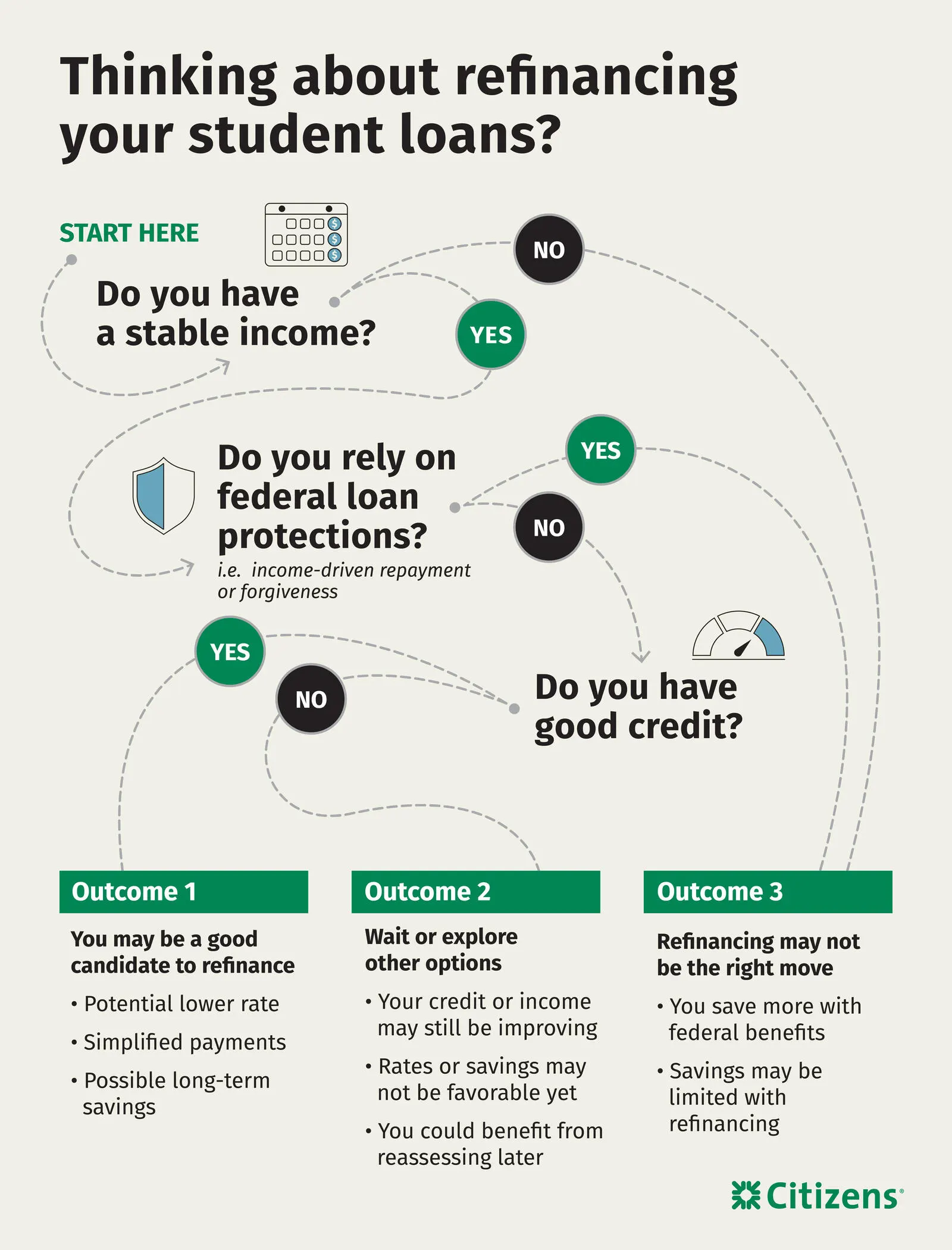
Refinancing with a private lender may allow you to consolidate all of your private and federal student loans. But while having just one loan payment may be appealing, you need to carefully review the pros and cons before refinancing your federal loans.
Federal loans offer attractive benefits, such as the ability to enroll in an income-driven repayment plan. These plans base your payments on your income, so you may qualify for a lower payment. However, if you refinance your federal loan to a private loan, you lose that opportunity.
Another federal loan benefit you could lose is loan forgiveness. If you work in certain types of public service jobs, you may be entitled to have portions of your federal loans forgiven. You won't be eligible if you refinance your federal student loans with a private loan.
Federal student loan refinancing considerations
The chart below highlights some of the benefits available with federal loans. Make sure you understand them before you consider refinancing your federal loans.†
| Potential federal loan benefit | What to think about |
| Income-driven repayment plans | Federal loan borrowers may qualify for a lower payment amount based on their income. |
| Loan forgiveness for borrowers in certain public service jobs |
Borrowers in certain types of public service jobs (government jobs, teaching jobs, the military, AmeriCorps, Peace Corps and many other nonprofit jobs) may be entitled to have portions of their federal loans forgiven. Most private lenders do not have loan forgiveness programs. |
|
Military benefits |
Active-duty military personnel are eligible for several federal loan benefits. However, some private lenders also offer military deferment and an interest rate cap. |
|
Longer medical and economic forbearance plans |
These plans may excuse repayment of federal loans for up to 24 months in the event of medical or economic hardship, which is more than what private lenders offer. New borrowers who take out loans on or after July 1, 2027, are not eligible for unemployment deferment or economic hardship deferment. |
|
Defaulted loan options |
You have options to remedy any defaulted federal loans, such as rehabilitation, consolidation or repayment in full. |
|
Employee repayment benefits |
Some employers, including certain public agencies and the military, include payments on federal student loans in their employee benefits packages. |
|
Loan forgiveness (if your school closed or committed fraud related to your loans or educational services) |
In rare circumstances, federal loans may be forgiven by the U.S. Department of Education if your school has closed or if you were defrauded by your school. |
If these benefits are important to you, a federal Direct Consolidation Loan may be a good alternative to student loan refinancing since you'll preserve your eligibility for federal loan benefits.
On the other hand, refinancing private loans is usually worth exploring. Whatever you decide, do your research so you can make a fully informed decision based on your individual needs and what works best for you.
Get started refinancing student loans
Refinancing student loans can help you reduce your monthly payments and simplify your finances. Evaluating your loan type, income and credit score can help you determine if refinancing is the right choice for your student debt.
Ready to get started? Discover the benefits of refinancing your student loans with Citizens†. You can get a personalized rate in about two minutes with no impact on your credit score.*