
How many bank accounts should I have?

Key takeaways
- There's no limit on how many bank accounts you can have. Opening new accounts can help you stay organized as you work toward your goals.
- Different bank accounts have different features and benefits. Some accounts may earn higher interest rates than others or come with cash back rewards or other perks.
- Online tools, automated features and account alerts make it easier to manage multiple accounts.
If you've heard friends and family talk about having multiple bank accounts, you may have wondered, "How many bank accounts should I have?" If you already have a checking and savings account, do you really need more?
The number of bank accounts you should have depends on your personal financial situation, and it's different for everyone. Let's take a closer look at why you might open additional accounts, the benefits they offer and how they can help you reach your financial goals.
How many checking accounts should I have?
There's no hard and fast rule about how many checking accounts any one person should have. The number and type of checking accounts that work for you will depend on your financial goals, spending habits and comfort level with monitoring and managing multiple accounts.
Most people have at least one checking account that serves as a central hub for managing their everyday spending. It's where you can deposit paychecks through direct deposit and pay bills with checks or online bill pay. A checking account also typically comes with a debit card for accessing your money and making purchases.
Many open additional checking accounts to simplify their finances. If you have a joint checking account for combined expenses but you also have individual financial goals, a separate account might make it easier to manage your money. And if you start a business, you'll need another checking account to separate your business and personal finances.
An additional checking account can also help you stay organized. For example, you might use one for your everyday spending and another to manage a home remodeling project. Many parents also open checking accounts for their teens to teach money management skills and prepare them for bigger financial responsibilities later.
How many savings accounts should I have?
Similar to checking accounts, the number of savings accounts you should have depends on your personal finances and goals. Most people have at least one to save for large goals like a new car, a down payment on a home, college tuition or other needs. Keeping these funds separate from your checking account helps you avoid spending the money you're setting aside.
You could open a separate savings account for each financial goal they're working toward. This makes it easy to track progress and stay organized. You might have one for a vacation, another to start a new business and a third to pay for an upcoming wedding. Savings accounts are also great for building an emergency fund to cover unexpected expenses like medical bills, car repairs and home maintenance.
Not all savings accounts offer the same features and benefits, and you may need multiple accounts for different purposes. You might keep funds for a short-term savings goal in a traditional savings account, and funds for a long-term savings goal in a money market account or certificate of deposit (CD). These accounts usually have a higher annual percentage yield (APY), which helps your balance grow faster through compound interest.
Benefits to having multiple bank accounts
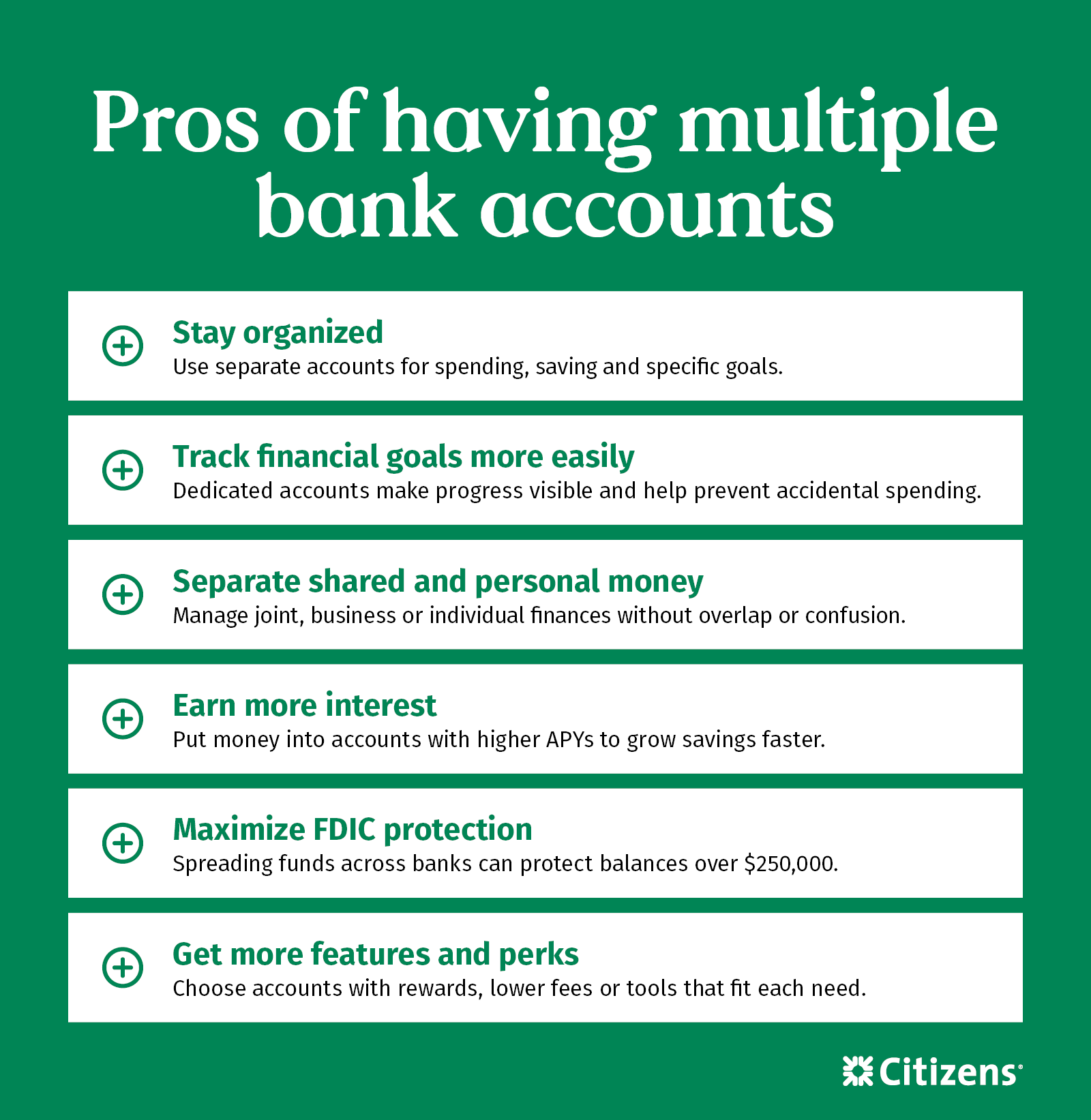
You can benefit from using different types of bank accounts for various purposes. Additional accounts can help you:
- Stay organized: Multiple accounts can make it easier to manage your money by having a separate account for each need or goal.
- Track goals: Keeping your savings separate from your checking enables you to track your progress. It may also help you resist dipping into your savings for purchases unrelated to your savings goals.
- Separate shared finances: You may prefer separate accounts if you and another person have different goals or spend money differently. Certain business entities, like limited liability corporations (LLCs), may also have separate accounts.
- Earn more interest: Some types of bank accounts earn higher interest rates than others, making them better suited for certain short-term or long-term goals.
- Get the most from FDIC insurance: The Federal Deposit Insurance Corporation (FDIC) insures deposits up to $250,000 per depositor, per ownership category, at each FDIC-insured bank. Some people keep deposits at different banks to help ensure their funds remain within FDIC insurance limits.
- Take advantage of different bank features: Some bank accounts offer cash back and other rewards. They may also have lower minimum balance requirements or no monthly maintenance fees.
Additional considerations for having multiple bank accounts
Before opening additional bank accounts, think about your needs and whether the new accounts will enhance your finances.
Here are some important considerations:
- Life stage: If you are just starting your career or you're at mid-career, having multiple accounts may help you organize your finances. If you are nearing retirement, you might prefer fewer accounts to simplify financial management and estate planning.
- Financial goals: Having a separate savings account for each goal helps you track your progress. Also, some accounts earn more interest than others, which can help you reach your goals faster.
- Income complexity: If you have multiple streams of income, having an account for each one makes it easier to track earnings and deductions.
- Family situation: You may want to establish separate bank accounts for your kids or other family members to set the stage for responsible spending and saving.
- Spending habits: Multiple bank accounts can make budgeting easier. Separating money into different categories may help you avoid overspending.
Your credit score usually won't be checked when you open new bank accounts. A credit check is typically performed when you apply for a loan or credit, like a personal loan, mortgage or credit card.
Keep in mind that it's possible to have too many bank accounts, which can make your finances more difficult and time consuming to manage. Accounts may also have minimum balance requirements. If you fall below the threshold, your account might earn less interest, or no interest at all. Monthly bank fees could also slowly drain your account over time or offset the interest you've earned.
How to manage multiple bank accounts
Keeping up with multiple bank accounts might seem challenging at first, but tools and strategies can make it easier and free up your time for other priorities.
Here's how to simplify account management:
- Use digital tools: Access accounts anytime through online or mobile banking. Check account balances, transfer funds, pay bills, track spending and take care of other banking tasks 24/7.
- Automate processes: Schedule automated and recurring bill payments to ensure you never miss a due date. Receive paychecks with direct deposit and schedule transfers from checking to savings to automatically grow your balance.
- Regularly review accounts: Check your accounts each month to monitor balances and make sure you’re on track to reach your goals.
- Set up alerts: Use text or email alerts to stay informed on deposits, low balances, withdrawals and other account activity.
Staying organized is the key to effective account management. Having all of your accounts with the same bank makes it easier to keep up with them. You can view accounts from your dashboard in online or mobile banking to quickly see balances and other information.
Multiple bank account FAQs
Are you still wondering if having multiple bank accounts is the right move? Here are some frequently asked questions to help you decide.
What are the benefits of multiple bank accounts?
Multiple bank accounts can help you organize your money, set goals and earn interest. Some banks also reward customers for having several accounts by waiving fees, allowing for easy transfers between accounts and offering higher interest rates.
Are there drawbacks to having multiple bank accounts?
Yes, there can be drawbacks to having multiple bank accounts. The more accounts you have, the more you have to keep track of, which can complicate your finances. Depending on the number of banks you work with and the fees involved, you may have to pay a lot to keep your accounts open. You may also have to spend more time monitoring your accounts.
Does having multiple bank accounts affect my credit score?
Having multiple bank accounts typically does not affect your credit score. However, if a bank reports negative account activity, such as an unpaid balance or account charge-off, it could affect your credit history.
How many bank accounts should married couples have?
There's no single answer to this question — the number of accounts a married couple should have can vary. Think about your joint financial goals and whether you each want to keep separate accounts when deciding on the number that's best for you.
How many are "too many" bank accounts?
While there's not a set number, you may have too many bank accounts if you're struggling to keep track of your accounts or to maintain the minimum balance required for each one. Another sign that you have too many accounts is if you're paying a lot in fees, such as monthly maintenance or low-balance fees.
Make sure your bank accounts are working for you
Whether you open one or several checking accounts, money market accounts or CDs, the right number of accounts is based entirely on your financial goals and needs. Think of what you want your money to do and then choose which accounts can do the heavy lifting for you.
Learn more about checking account options at Citizens.
Related topics

How to open a joint bank account
Getting married or merging households? A joint bank account can simplify your finances and make it easier to manage your money.

Money market vs. savings accounts: What's right for you?
Money market and savings accounts have different features and benefits. See how they compare to find the best option for your needs.

How to plan for short- and long-term savings goals
Short- and long-term savings goals require different approaches. Discover strategies to maximize your savings potential.
© Citizens Financial Group, Inc. All rights reserved. Citizens Bank, N.A. Member FDIC
Disclaimer: The information contained herein is for informational purposes only as a service to the public and is not legal advice or a substitute for legal counsel. You should do your own research and/or contact your own legal or tax advisor for assistance with questions you may have on the information contained herein.