

Medical and dental school graduates carry some of the heaviest student debt of any profession. The average medical school debt is about $216,000. It's even higher for dental school graduates, who carry an average dental school debt of around $280,000. If student loan payments are straining your budget, refinancing can be a powerful tool to help you get some relief.
Refinancing can lower your payment or adjust your term, depending on the current interest rates and your financial situation. Three factors that may affect your refinancing decision include your loan type, career path and the timing.
Can you refinance medical school loan debt?
Refinancing can be one way to effectively manage medical and dental school loans while lowering your rate. Commonly known as a "refi," refinancing involves changing the terms of one or more existing loans in favor of better conditions, which includes a potentially lower interest rate. Simply put, a refi is when one or more loans are replaced with a single loan. And with the right lender, the process can be done quickly and efficiently.
A refi is a particularly good option for medical residents and fellows who expect to make a high salary, for example as an attending physician or an oral surgeon. By refinancing early, medical and dental residents can start saving now, before their peak earning years.
The Citizens Medical Residency Refinance Loan was created to provide some stress relief for medical doctors and dentists during their residency.† With this refi, we pay off your existing medical school debt with a new loan, oftentimes at a lower interest rate which could possibly save you thousands of dollars a year.
You can refinance both federal and private student loans into a single, convenient monthly payment, simplifying your finances. Flexible term-length options allow you to choose the option that best fits your needs and budget.
Federal loans vs. private refinancing
All private and federal loans can be refinanced and consolidated into one payment with flexible options, depending on your credit profile. The government offers federal student loan consolidation options. However, if you refinance with a private lender, you can roll both federal and private loans into one refinanced loan.
A potential disadvantage of refinancing federal student loans with a private lender is that those loans become private permanently, and you lose the benefits that federal loans offer.† For example:
- You're no longer eligible for Public Service Loan Forgiveness (PSLF), which offers tax-free forgiveness of your student loan after 10 years of qualifying payments while working at a nonprofit or for a government employer.
- You lose access to income-driven repayment (IDR) plans that can cap payments as a percentage of your income.
- You can't take advantage of federal deferment (paused payments) and forbearance (reduced or paused payments) options if you experience a financial hardship.
- You miss out on potential access to future federal relief programs that can make a difference when money is tight.
However, if you have only private loans, there are very few downsides to refinancing when a lower rate is available. It's almost always worth exploring whether refinancing will lower your payment or reduce your interest.
When refinancing dental and medical school loans makes sense
Borrowers typically refinance medical school loans and dental school loans for these reasons:
- A more favorable interest rate
- Ability to consolidate several loans into one payment
- Mitigate risk (switch from a variable rate to a fixed one)
- Reduce the monthly loan payment
- Pay off debt faster
Before you refinance, consider the types of loans you have, your professional specialty and your future expected earnings. Refinancing may only make sense in certain scenarios.
1. You have private student loans
Private loans don't include federal protections, so refinancing them to a lower rate typically doesn't involve giving up those benefits. The potential rewards can be high: Reducing the rate by just one or two percentage points could save thousands of dollars over the life of the loan.
For example, say you have a $200,000 private student loan with a 10% interest rate and a 10-year term. That gives you payments of about $2,643 per month, and you'll pay nearly $117,162 in interest.
In this scenario, if you refinance into a new private loan at 8% and a 10-year term, your payments will be about $2,427, and the total interest you'll pay drops to around $91,186. You'll lower your payment by $216 and save nearly $25,976 in interest over the life of the loan.
2. You plan to work in private practice
To qualify for Public Service Loan Forgiveness (PSLF), you must work at a qualifying nonprofit or government organization. If you enter private practice or work for a for-profit organization, PSLF won't be an option. In this case, refinancing federal student loans might help you restructure your debt with a more favorable payment and term.
3. Your credit and income position you for a lower rate
Your credit score and income both influence loan approval and the interest rate you qualify for. Your monthly debt payments compared to your monthly income is also a factor in assessing creditworthiness. After completing a residency or fellowship and starting your career, you'll likely have a stable income, which may help you qualify for a student loan refi with a competitive rate.
4. You want to simplify multiple loans into one payment
Many medical and dental students graduate with a mix of federal and private loans from multiple lenders. Keeping up with several monthly payments can be challenging, and accidentally missing payments could result in late fees and harm your credit score. Refinancing allows you to consolidate these loans into a single monthly payment with one lender, which simplifies your finances and makes budgeting easier.
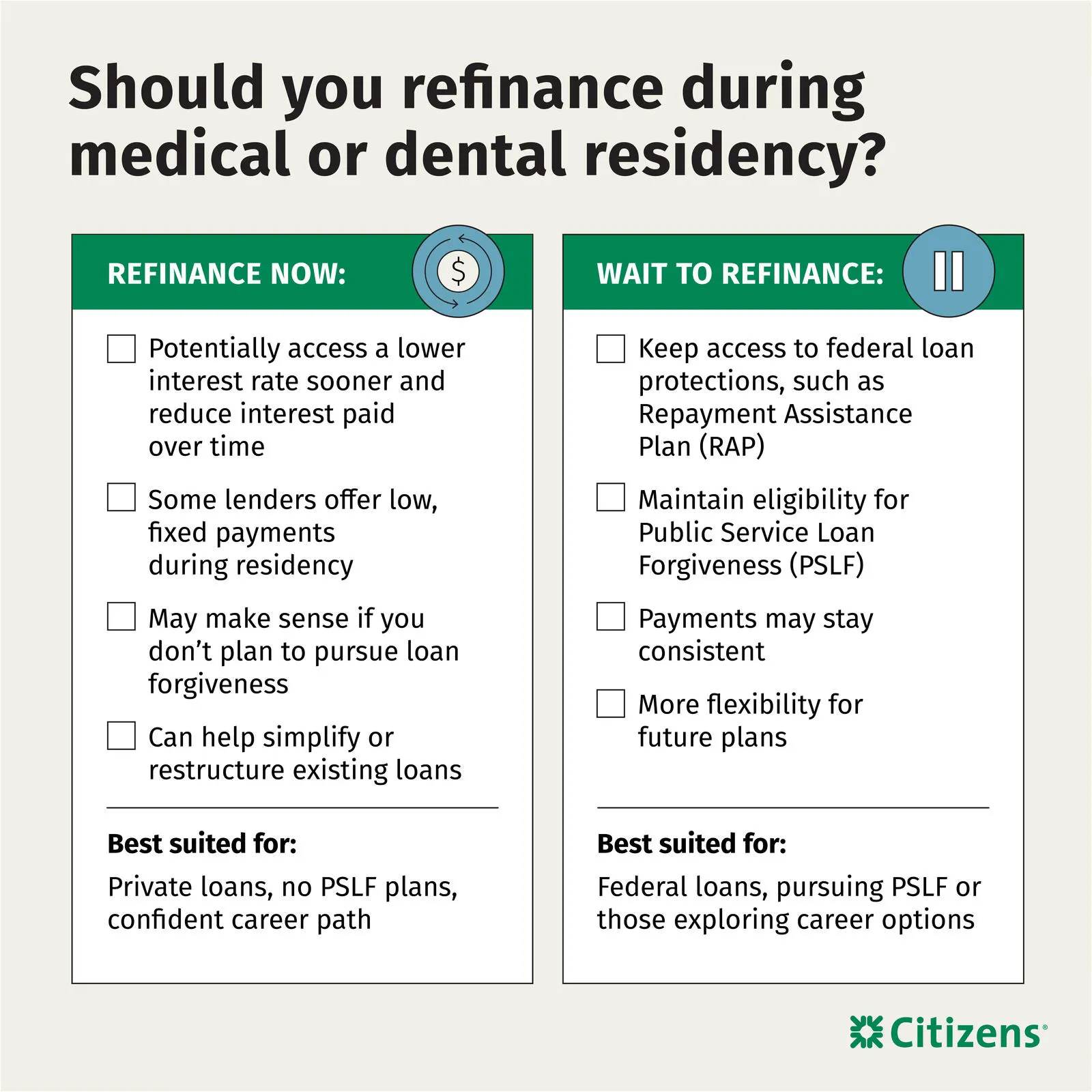
Should you refinance during residency or wait?
If you're in a residency program or fellowship, you might be wondering whether you should refinance your student loans now or wait until your income is higher and more stable. The choice can affect your borrowing costs and payments, so it's important to consider the specifics before deciding.
Interest accrual
Rather than refinancing, many students turn to deferment or forbearance to temporarily pause their payments during residency. While this can provide much-needed financial relief, interest will continue to accrue. For example, a $200,000 loan balance at 6.39% interest accrues $35 in interest per day, or $12,780 per year. The added costs may increase your payment and the total interest you pay over time.
Loan forgiveness
Refinancing may be a sound financial move if you're certain your career path does not include PSLF-qualifying employment. If you wait to refinance, a rate increase could add to your borrowing costs. However, if you are uncertain about your post-residency path, it may make sense to wait.
Medical vs. dental school
Whether you are in medical or dental school is another important consideration. Dental school graduates often begin earning attending-level income sooner than physicians, which may make an earlier refi more practical. You'll start making payments on your loan sooner, and you'll avoid deferment or forbearance, which can extend the repayment period and accrue additional interest.
IDR plans
Finally, keep in mind that if you refinance federal student loans during your residency or fellowship, you will no longer be eligible for an IDR plan, where payments are based on your income and family size instead of the loan amount. An IDR may keep your payments very low while you finish your training, so be sure to do your research before deciding.
If you decide to refinance during residency, one option is to use a program designed for residents and fellows. Some lenders, like Citizens, offer student loan refinancing programs that fix monthly payments at a reduced amount during the training period. This allows you to lock in a lower rate, giving you some extra room in your budget.
How to refinance dental school loans and medical school loans
Medical residents and dental fellows with loans should take the following steps before committing to a refi.
- Know your loans: Identify every loan by type (federal vs. private), balance, interest rate and lender. Federal loans are listed at studentaid.gov.
- Assess your PSLF eligibility: Research your current and expected employer type before refinancing any federal loans.
- Check your credit: Most lenders offer soft credit checks that don't affect your score; use them to estimate rates before committing.
- Compare lenders beyond the rate: Look at repayment term options (5-20 years), forbearance provisions, autopay discounts, residency-specific programs and cosigner release options.
- Gather documentation and apply: Expect to submit proof of degree, employment verification, income documentation and current loan statements.
The Citizens Medical Residency Refinance Loan helps physicians and dentists manage their loans during training.† After refinancing, you could have a low, fixed monthly payment of just $100* during your residency or fellowship, freeing up cash for living expenses. You may qualify to borrow up to $750,000, which may cover all of your student debt.
Additional benefits include:
- No origination or service fees
- No early repayment penalty
- Competitive rates and terms
- Consolidation of multiple loans into one payment
In addition to low rates, you can also qualify for a 0.25% discount when you sign up for Automatic Monthly Payments. If you have a qualifying Citizens account, you can also enjoy a 0.25% Loyalty Discount. Combined, they can cut your rate by 0.50%, helping you save even more.†
Make the best refinancing decision for you
Refinancing medical or dental school loans can be a smart way to manage your debt. Whether it's a good option for you depends on the loan type and your career path. Before applying, consult with a student loan specialist or financial advisor who can run the numbers to see if you'll come out ahead.
Ready to refinance? Citizens can help. Learn more about the Citizens Medical Residency Refinance Loan. Get your rate with no impact on your credit score, and start your application today.† 1