
Where is the best place to save money? Choosing the right accounts for your goals

Key takeaways
- Where you save your money based on the access you need matters just as much as what you save. A savings framework helps you determine the best account for your needs.
- Different account types serve different purposes. Matching your money to the right account can help you balance access and growth.
- Look for FDIC-insured deposit accounts to help protect your money, while organizing savings across accounts to maximize flexibility and potential.
If all your money is currently sitting in a checking account, you may be wondering whether it's working hard enough for you or is organized in a way that helps you reach your goals.
Checking accounts are ideal for everyday spending, but they may not be the best option for building your savings. The best place to save money is in an account that gives every dollar a clear purpose. Establishing a three-part savings framework for cash on hand, savings for goals and longer-term growth can help you determine the right accounts for your needs.
Where you save matters as much as what you save
Where is the best place to put money to save? Many people don't realize that different deposit accounts, such as checking and savings accounts, serve different purposes and how you organize your money based on when you'll need it and what it's for determines the return, access to your funds and the level of risk.
Some savings accounts focus on keeping your money stable and providing easy access to your funds when you need them. These accounts are generally considered low risk. You can use other account types for longer-term goals, where growth potential and access to funds can vary based on how the money is used.
Any deposit account you consider should be FDIC-insured. The Federal Deposit Insurance Corporation (FDIC) insures accounts with banks, while the National Credit Union Administration (NCUA) insures accounts with credit unions.
Organizing your savings by purpose helps you balance security, growth and access. For example, a traditional savings account offers a modest APY and easy access to your funds, making it a good option for a short-term savings goal. A certificate of deposit (CD) offers a higher APY but requires you to keep your money in the account for a set period, making it better suited for a long-term savings strategy.
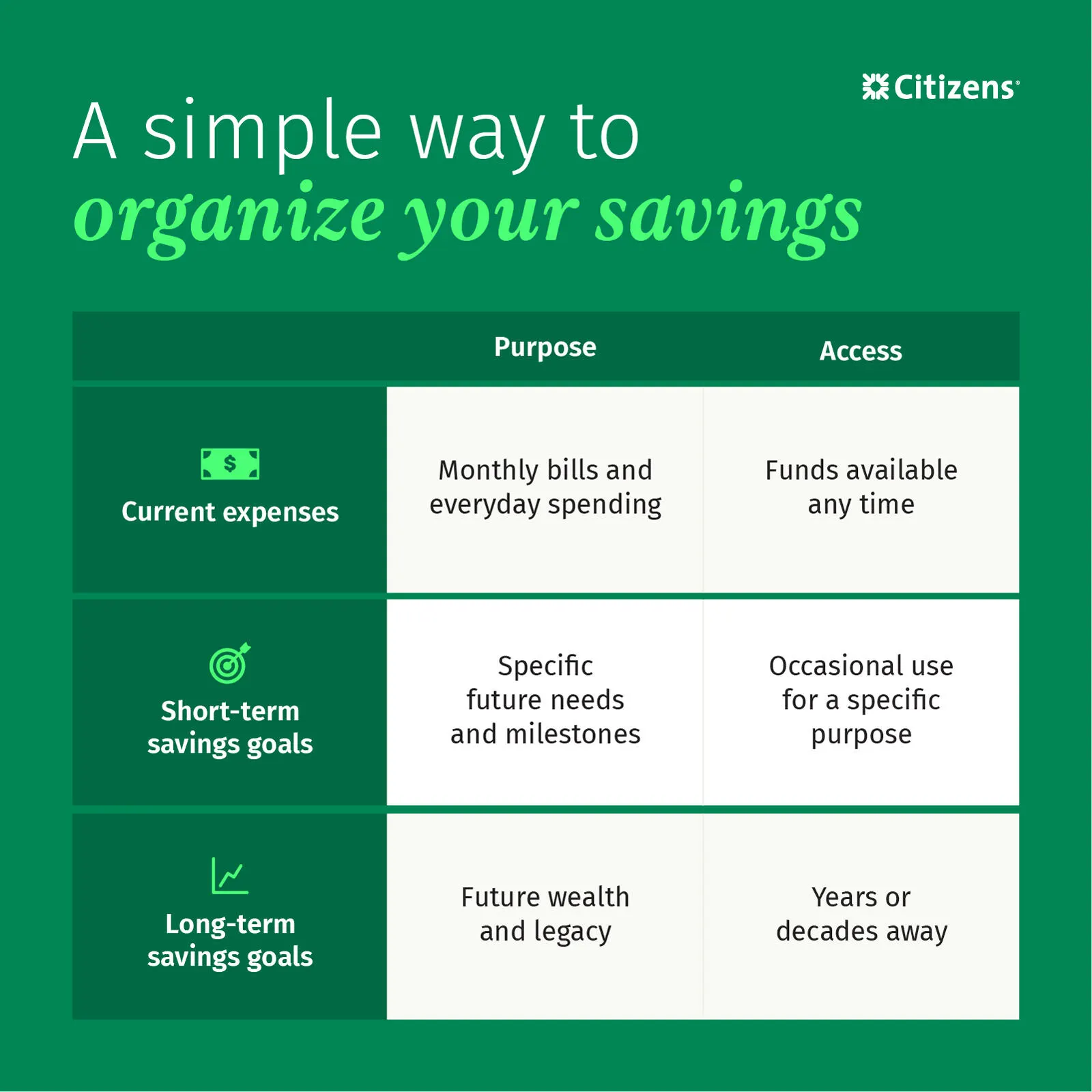
Establishing a savings framework
The best way to choose the right savings accounts is to use a three-part savings framework. With this approach, you organize your money by role instead of by account name. This makes saving feel less overwhelming and more intentional.
The three parts of the savings framework include:
- Cash on hand
- Savings for shorter-term goals
- Longer-term goals
Each part of the framework has supporting savings account options. The right choice often depends on what you want your money to do, your timeline and how often you need to access it.
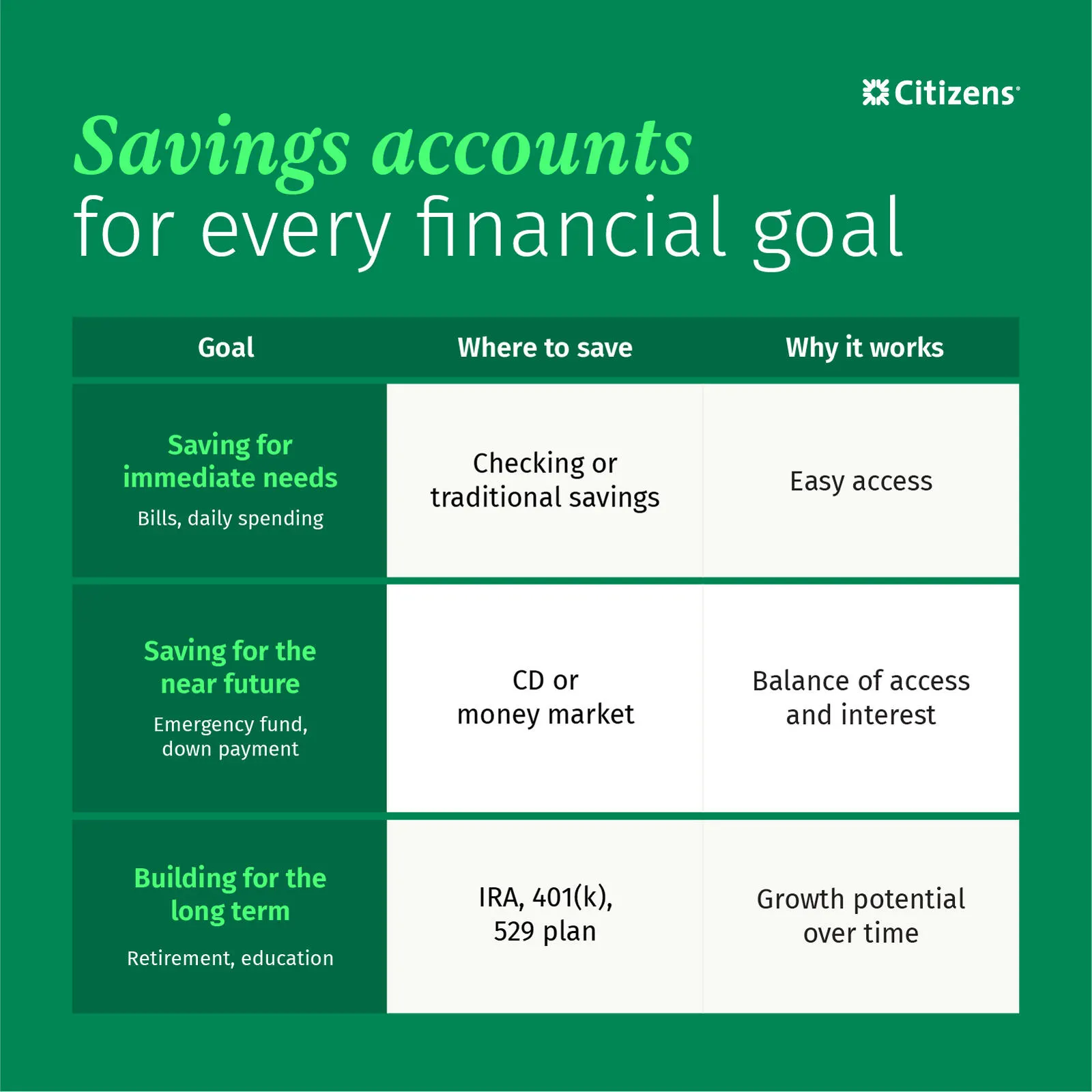
1. Saving to have funds available for immediate needs
The first part of the savings framework includes money set aside for day-to-day expenses you may need in the next 30 days. You'd typically use these cash-on-hand funds for groceries, gas, entertainment, bill payments and other living expenses.
Liquidity is the primary consideration when selecting an account for immediate needs. You should have access to your money at any time without penalty. The best places to save money for funds you need to access frequently are checking and traditional savings accounts.
Checking and traditional savings accounts
Many people have both of these account types for short-term needs. Understanding the differences between a savings account vs. checking account can help you understand how they complement each other.
With a checking account, you can easily access your money anytime by writing checks, making debit card purchases or paying bills online. If you're wondering where to keep an emergency fund or temporarily park money between goals, a traditional savings account works well.
You can keep enough in your checking account to cover your monthly expenses and then move the rest into higher-earning accounts to grow your savings over time. When you need funds, you can transfer them back to your checking account through online or mobile banking.
2. Saving for goals
The second part of the savings framework is money you're saving for short- to mid-term goals, like a vacation, kitchen renovation or new appliances. This is money you expect to need within one month to five years.
Savings accounts for goals should ideally earn a higher APY than traditional savings accounts to help grow your balance over time. At the same time, you need reasonable access to your money. Three account options for goals include high-yield savings accounts, money market accounts and certificates of deposit.
Interest-bearing savings accounts
Money market accounts (MMAs) often come with check-writing privileges or a debit card, which gives you easy access to your money. They also offer higher APYs than traditional savings accounts, although they may have higher minimum balance requirements. An MMA is a versatile mid-range option for goals that are six months to two years out.traditional savings accounts, although they may have higher minimum balance requirements. An MMA is a versatile mid-range option for goals that are six months to two years out.
Certificates of deposit (CDs) offer fixed APYs and require you to leave your money in the account for a set term ranging from a few months to several years. While it's possible to withdraw money before the maturity date, you may have an early withdrawal penalty. A CD may be a good savings option for a specific goal with a known timeline, like for a down payment on a home in two to five years.
Other options, such as high-yield savings accounts (HYSAs), may offer higher APYs than traditional savings accounts, but may also come with minimum balance requirements or withdrawal limits. HYSAs are best for emergency funds and short-term goals of up to 12 months.
Although CDs are not liquid like HYSAs or MMAs, you can use a strategy known as CD laddering to maintain liquidity by opening CDs with staggered maturity dates so there's always one maturing soon. When a CD matures, you can reinvest at the new rate or use your funds for another purpose.
3. Saving for longer-term goals
The last part of the savings framework is money you're saving for long-term goals, such as retirement, wealth building, education savings and goals that are more long term. These investment and retirement accounts often involve different considerations, such as tax treatment and long-term growth potential. Specialized long-term savings accounts help you prepare for future needs with benefits that help you grow your savings over time.
Retirement accounts
Individual Retirement Accounts (IRAs) and 401(k) accounts both help you save for your retirement goals. An IRA is an account you set up yourself, while a 401(k) is an employer-sponsored account. Both have annual contribution limits.
Traditional IRAs and 401(k) plans are tax-deferred accounts that have tax-free growth potential, but withdrawals are taxed as ordinary income. With a Roth IRA, you make contributions with money that has already been taxed, so qualified withdrawals in retirement aren't taxed.
Many employers offer a 401(k) match, contributing a certain amount for every dollar you contribute. If your employer offers this benefit, consider contributing at least enough to capture the full match as part of your overall savings approach.
Keep in mind that a retirement account is not a substitute for emergency savings you can easily access. Although you can make early withdrawals from a retirement account, you may face early withdrawal fees and taxes that could make it harder to reach your retirement goals.
Education accounts (529 plan)
You can use a 529 plan to save for a child's or grandchild's K-12 or college tuition expenses. Qualified expenses may also include:
- Books, supplies and fees
- Computers and software
- Room and board (up to school's cost of attendance for housing)
In general, 529 plans have high contribution limits, flexible beneficiary rules and potential tax-free growth over time. Many states also offer income tax deductions or credits for contributions to these plans. Funds withdrawn for non-education purposes may incur taxes and penalties.
As the cost of education continues to increase, a 529 plan can help you prepare for future expenses. The key is to start as early as possible and make regular contributions. Even small monthly contributions can add up over 10 to 18 years.
How to build your own savings framework
Knowing how to organize savings helps you select the right types of accounts for your needs and goals. To build your own savings framework, start by identifying your purposes:
- What do you need cash for right now?
- What are you saving for in the next year or two?
- What are you building toward for the long term?
Once you know what you want to do with your money, assign each dollar a role based on the three-part framework. Match each role to the right account type using the guidance above.
Periodically review your savings progress. Digital tools like mobile banking apps and savings goal trackers make it easy to see how you're doing. Automatic transfers from checking to savings can also help you stay consistent if you're busy and forget to make contributions.
Be sure to review your framework twice a year. If your goals or income change, you can update your accounts to better reflect your needs.
Common savings mistakes to avoid
The right savings account and consistent contributions can help you reach your goals, but certain missteps can derail your progress. Here are some common mistakes to watch for:
- Keeping all of your money in a checking account: By not moving funds you don't need within 30 days to a savings account, you'll miss out on compound interest.
- Not reading the terms for a high-APY account: Accounts may have minimum balance requirements or withdrawal limits. If you fall below the minimum balance, you may incur fees, and withdrawal limits make it harder to access funds when you need them.
- Opening a CD without an emergency fund: If you need to access funds in a CD, you may incur an early withdrawal penalty. Not having an emergency fund for unplanned expenses can make it harder to reach your savings goals.
- Waiting to save until "there's more money": The longer you wait to start saving, the more difficult it becomes to reach your goals. Small, consistent contributions can add up over time.
- Mixing purposes in one account: If you keep all your money in one account, it's harder to track your savings progress. Some accounts are designed for certain goals and offer specific benefits to help you reach them.
Save with a purpose
The best place to save money is the one that's aligned with your goal, where every dollar has potential and a purpose. Review your current savings setup today and look for one small change you can make right away. The sooner you take action, the sooner you can optimize your savings strategy.
Ready to start saving? Explore Citizens savings account options to find the best fit for your needs.
Related topics

Short-term, midterm and long-term savings goals: How to save
Discover how to optimize your savings depending on how far in the future each of your goals is.

How many savings accounts should I have?
Savings accounts help you manage your different savings goals and timelines. Explore the ideal number of accounts for your needs.

Money market vs. CD
Both money market accounts and CDs can help you save money, but they work differently. Discover the pros and cons of each.
© Citizens Financial Group, Inc. All rights reserved. Citizens Bank, N.A. Member FDIC
Disclaimer: The information contained herein is for informational purposes only as a service to the public and is not legal advice or a substitute for legal counsel. You should do your own research and/or contact your own legal or tax advisor for assistance with questions you may have on the information contained herein.
Citizens Wealth Management (in certain instances DBA Citizens Private Wealth) is a division of Citizens Bank, N.A. ("Citizens"). Securities, insurance, brokerage services, and investment advisory services offered by Citizens Securities, Inc. ("CSI"), a registered broker-dealer and SEC registered investment adviser - Member FINRA/SIPC. Investment advisory services may also be offered by Clarfeld Financial Advisors, LLC ("CFA"), an SEC registered investment adviser, or by unaffiliated members of FINRA and SIPC providing brokerage and custody services to CFA clients (see Form ADV for details). Insurance products may also be offered by Estate Preservation Services, LLC ("EPS") or an unaffiliated party. CSI, CFA and EPS are affiliates of Citizens. Banking products and trust services offered by Citizens.
SECURITIES, INVESTMENTS AND INSURANCE PRODUCTS ARE SUBJECT TO RISK, INCLUDING PRINCIPAL AMOUNT INVESTED, AND ARE:
· NOT FDIC INSURED · NOT BANK GUARANTEED · NOT A DEPOSIT · NOT INSURED BY ANY FEDERAL GOVERNMENT AGENCY · MAY LOSE VALUE