
Key questions to consider when building your business exit strategy

By Manny Tocco, Citizens National Head of Business Banking
Key takeaways
- Understand the options. Business exits range from a full sale to a partial or gradual transition. Each option carries different financial, ownership and tax implications, and many owners aren't aware of all the choices available to them. Learn about potential exit paths as a key first step.
- Know what drives value. Business value is shaped by earnings consistency, revenue quality, management independence, and operational strength, not just top line revenue. Understanding what buyers and successors look for helps with planning and decision-making.
- Build a team early. A business banker is a good starting point for assembling a team with experience in exits of similar size and complexity, including tax and estate advisors and attorneys who have planned and executed transactions like yours before.
Exit strategies come in many forms. Some owners exit completely, and others step back partially or gradually over time. What's consistent across all exits is the need for coordinated planning between an informed owner and a team of advisors who know how to maximize and convey a business's value.
To arrive at the optimal exit strategy takes time.
Citizens research makes clear that owners understand the importance of starting this preparation early. Among businesses with $5M+ in annual revenue who have already started planning their sale or transfer or ownership, 30% began the process one to three years ago and 15% started as long as five years in advance. These six questions come up most often when business owners begin planning for an exit.
Why is succession planning an important part of an exit strategy?
An exit strategy focuses on the financial outcome of an exit, meaning how an owner will obtain value from the company they've built. A succession plan maps out who will lead the company after current owners or leaders step down. Since buyers want confidence that the business will continue to run well after a change in ownership, succession planning is typically built into a strong exit strategy.
What options are there for an exit strategy?
Exit strategies run the spectrum from a complete ownership transfer to partial exits that let an owner stay involved and invested. Advisors are going to play a key role in selecting the right path, but the more an owner knows, the better job a team of advisors can do.
Knowing what the options is an important first step in building a plan.
Full and majority exit strategies
| Empty cell | What is it | What it provides |
| Sale to a strategic buyer | A sale to a business that values your customer relationships, market position, technology or capabilities. | Strategic buyers may pay a premium because a business adds immediate value to theirs. |
| Sale to a financial buyer | A sale to a private equity firm or family office that acquires a business as an investment, typically partnering with existing management to operate and grow it. | Financial buyers bring capital and operational expertise. Private equity buyers typically plan to sell within 3-7 years; family offices prefer to hold longer term. |
| Management buyout | An existing management team buys a business from the current owner, usually with their own capital plus outside financing. | Provides strong leadership continuity since the buyers have been helping to run the business already. |
| Employee stock ownership plan (ESOP) | Employees gradually acquire ownership via a company-funded retirement trust. | Rewards loyal employees, preserves company culture, and may have owner tax advantages. |
Partial and flexible exit options
| Empty cell | What it is | What it provides |
| Minority sale | An owner sells a stake, typically less than 50 percent, to a financial or strategic investor while retaining majority control and operational authority. | Access to outside capital and expertise without relinquishing control of the business or committing to a full exit. |
| Recapitalization | A financial or strategic investor acquires a majority stake in the business while the owner retains a minority ownership position. | Provides liquidity while keeping the owner invested in future growth. |
| Dividend recapitalization | The business takes on debt through a bank or private lender to fund a substantial dividend to the owner. | Provides immediate liquidity without transferring any ownership or bringing in outside investors. |
| Asset sale | The owner sells specific assets such as a product line, a division, or equipment rather than the entire business. | Useful when only part of the business holds strategic value to a buyer, or when the owner wants to wind down selectively. |
| Orderly wind-down | A business ceases operations in a planned way. Assets are sold and obligations settled. | Typically pursued when a sale or transfer is not viable or when the owner chooses to close. |
Owners considering selling a business benefit from understanding the preparation and process involved as part of this specific type of exit planning.
How do I know if I am picking the right exit option?
Exit strategy decisions involve complex financial, legal, tax and estate planning dimensions, and the reality is that an advisory team is really going to be key to this decision-making. Leaning on advisors means that a business owner doesn't pick an exit strategy based just on personal preferences or ideas about what should work. If you start with a business banker, they can help you build a team of advisors with experience with businesses of your size and in your industry. A team will typically include a banker, M&A advisors, CPAs, and estate planning attorneys.
Even though an advisory team will drive the process, everyone benefits when owners understand the factors involved.
Financial goals. Various exit strategies produce different financial outcomes, both in the amount an owner receives and the timing of those proceeds.
Taxes. Exit structure can significantly impact tax implications for an owner and often contributes to which strategy makes the most sense.
Business and market conditions. The financial performance of a business and current market and sector conditions affect both optimal exit timing and the best strategy.
Management team. The depth and independence of a company's leadership team affects which exit options are viable and which one makes the most sense.
Post-exit role. Some exit paths require the owner to remain involved for an extended period, while others allow a clean exit at closing.
Employee and customer continuity. How different exit paths affect employees, culture, and customer relationships is a meaningful factor for owners who care about the legacy of what they have built.
When is the right time to execute a business exit?
Smart exit timing depends on what is happening in the market around the business, and what is happening inside the company. These external and internal factors have to be balanced to arrive at the best time for an exit.
External
- Business financial health is strong and consistent.
- Industry is growing or experiencing active acquisition activity.
- Competitive dynamics: Active acquisition of companies in the same sector signals strong buyer demand.
- Regulatory: Current or pending regulatory or tax policy changes are favorable.
- Interest rates and capital availability are favorable.
Internal
- The management team can operate independently without the current owner.
- Financial statements are clean, well documented and reflect true earnings.
- No single customer, market, or revenue stream represents an outsized portion of the business.
- Core operational processes are documented, repeatable and not dependent on any single person.
- A current business valuation has been completed and aligns with the owner's financial goals.
- A qualified advisory team is in place or has been identified.
What actually drives business value?
Outside buyers and internal successors are going to value a business based on how well it is run now and whether it can maintain momentum after management or ownership changes. A business owner and their team of advisors spend time before going to market strengthening the key fundamentals that impact valuation.
- Financial performance. Consistent revenue growth and predictable cash flow show momentum and provide confidence that the business can sustain itself through and after a transition.
- Revenue quality. Recurring income through contracts or retainers, a diversified customer base, and revenue spread across markets and products will be viewed as more resilient.
- Independent management team. A business that runs without its owner is valuable because it makes buyers confident that success can be maintained with new management or owners.
- Proprietary products or technology. Competitive advantages that are difficult to replicate give a business strategic value.
- Operational strength. Buyers view a business with current technology, well-maintained facilities, and documented processes as easier to run without disruption.
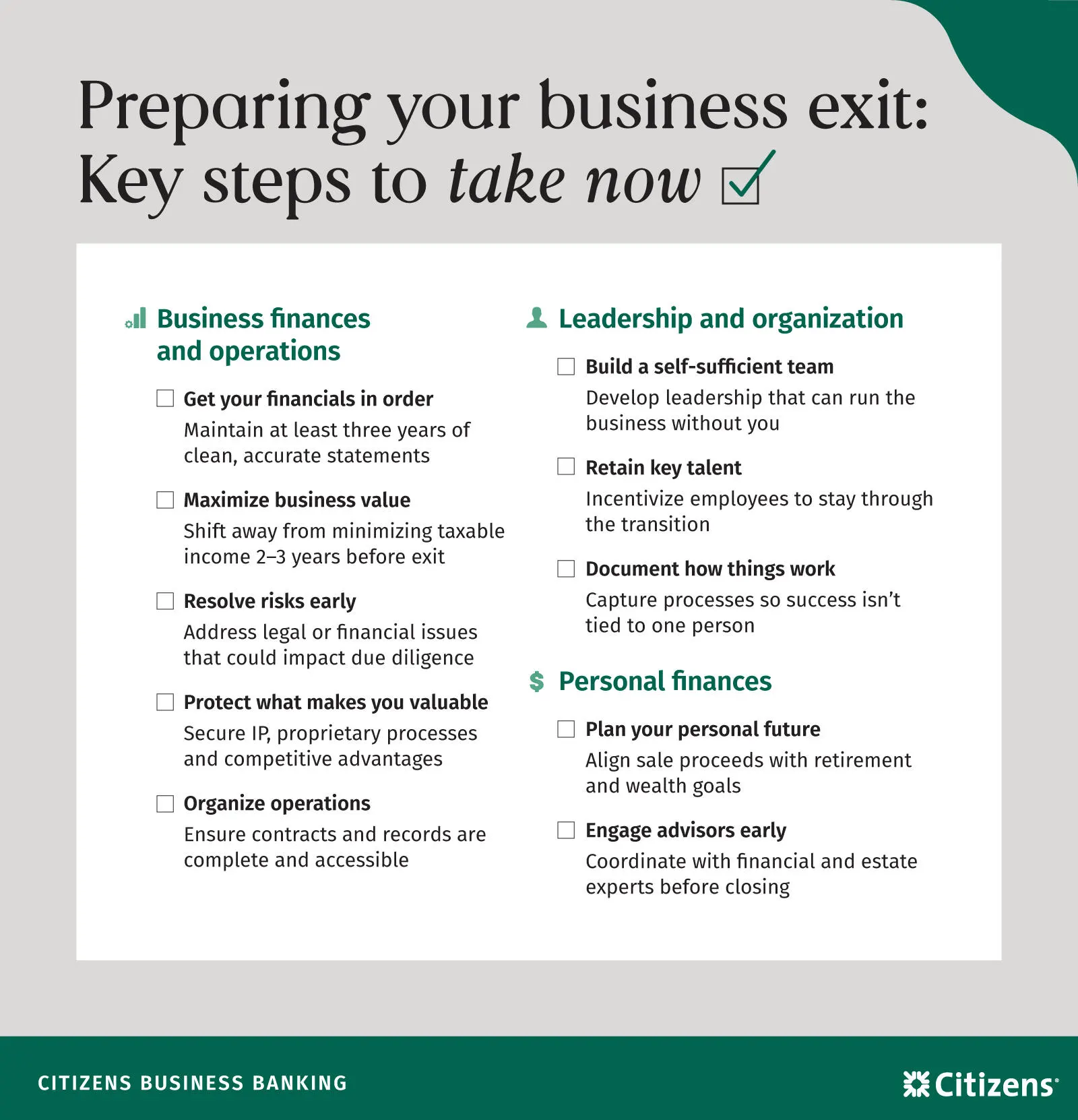
How should I prepare for an exit?
Not everyone realizes the important role owners play leading up to and during an exit. An advisory team will manage most of what happens once things are in motion, but what owners do before and during the exit definitely impacts the outcome. Some of the areas where owners' preparation and involvement matter most are listed here:
Business finances and operations
- Prepare at least three years of financial statements that are clean, accurate, and easy for a buyer or successor to understand.
- If managing taxable income downward, begin shifting that approach two to three years before a planned exit, as every dollar of suppressed earnings reduces what the business is worth.
- Address any outstanding legal or financial liabilities that would surface during due diligence and give a buyer leverage to renegotiate.
- Document and protect intellectual property, proprietary technology, and any competitive advantages that support the business's strategic value.
- Organize customer contracts, supplier agreements and operational records so they are complete and accessible.
Leadership and organization
- Build a management team that can operate independently of current owners or managers to drive a good valuation and generate stability during transition.
- Retain and incentivize key employees. The loss of critical talent during a sale or succession can affect value and deal certainty.
- Document core processes and institutional knowledge so the business is not dependent on any single individual.
Personal finances
- Assess whether the expected proceeds from a transaction fully fund retirement and long-term wealth goals before committing to a path.
- Engage a wealth advisor experienced with liquidity events to develop an investment and tax strategy for proceeds before a transaction closes.
- Work with an estate attorney to ensure ownership transfer structures are in place and aligned with long-term wealth transfer goals.
Business owners planning for life after ownership may also benefit from exploring retirement planning options.
Every strong exit starts with preparation
Whether an exit leads to a sale, a transition or a handoff to another team, the outcome depends on preparation. Proving that a business can thrive without the current owner or management team is essential; so is communicating that the fundamentals of a business are solid and will stay that way. Teamwork between an informed owner and the right advisory team can prepare a business and convey its value at the right time.
Thinking about what’s next for your business?
Related topics

Why it pays to know what your business is worth
Learn why understanding your business's value is so important.

Small business succession planning: 4 key options to consider
Four options to consider when planning business succession.

Self-employed retirement plans: 6 options to consider
What are your retirement plan options if you're self employed?
© Citizens Financial Group, Inc. All rights reserved. Citizens Bank, N.A. Member FDIC
Disclaimer: Views expressed may not necessarily reflect those of Citizens. The information contained herein is for informational purposes only as a service to the public and is not legal advice or a substitute for legal counsel. You should do your own research and/or contact your own legal or tax advisor for assistance with questions you may have on the information contained herein.