

If you have student loan debt, you're not alone. It takes the average borrower about 20 years to pay off their loans from school, and more than 20% of borrowers see their total debt go up, not down, five years after graduation. The interest rate, loan term and monthly payment all impact how much you pay and how long it takes to repay the debt. In some cases, you may be paying more than you need to.
What does it mean to refinance a student loan?
What is the point of refinancing student loans? Refinancing your student loans can mean a lower interest rate, lower monthly payment, different loan term or a combination of all three. When you refinance, you essentially trade one loan for another to get a better offer. It's not right for every borrower, though. Explore the pros and cons of refinancing before deciding if it's the right option for your student loans.
What are the pros of refinancing student loans?
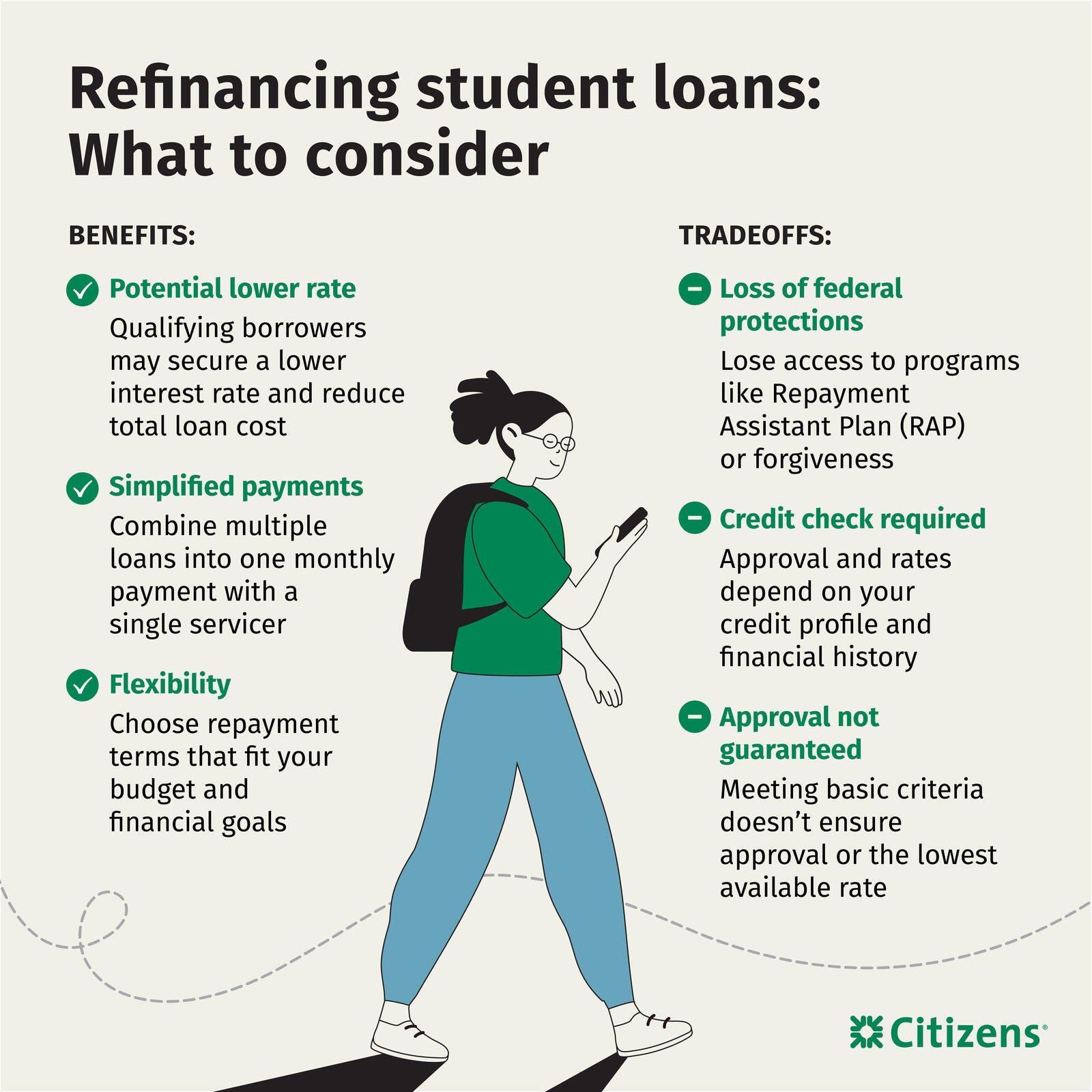
For some borrowers, refinancing student loans can offer significant benefits, including lower payments and reduced interest rates. Your specific loan types and terms can help you determine if refinancing makes sense for your personal financial situation.
Lower interest rate
Student loan refinance interest rates can vary based on several factors, including your credit score, your financial situation and market conditions. Your score may have improved since you first borrowed, meaning you could get a lower rate by refinancing now. Interest rates may have also gone down since you first borrowed.
For example, assume you're currently paying 8% interest on a $30,000 loan. Over a 10-year repayment term, you'd pay $13,678.11 in interest. If you refinance to a loan with 5% interest, you'd pay just $8,183.45 in interest over 10 years, saving you $5,494.66.
Reduced monthly payment
When you refinance, you can choose a loan with a longer payment term. You can go from 10 years to 15 or 20, for instance. Extending the term of your loan reduces your monthly payment, freeing up cash in your budget for other expenses. Refinancing your loan to reduce the interest rate also typically results in a lower monthly payment.
Keep in mind that while extending the repayment term does equal a lower monthly payment now, it means paying more over time. If you'd like and your budget allows, you can always pay extra toward your loan to speed up repayment.
Simplified loan management
You may have walked away from your college graduation with a degree and loans from several providers, including both federal and private lenders. Depending on how many different loans you have, keeping track of what's due when and how much you have left to pay on each one can get complicated.
When you refinance, you can combine your loans into a single loan. Managing one monthly payment, one due date and one interest rate helps simplify your finances.
Cosigner release
If you took out private student loans when you were an undergraduate without an income, you may have needed a parent cosigner on those loans. Now that you're working and have had time to build up your credit, you may no longer need someone to cosign your loans. Refinancing is one way to release your cosigner so they're no longer responsible for the loan.
Switched rate types
You can refinance from a variable interest rate to a fixed rate or vice versa. A variable rate may be lower at refinancing, but there's always the risk it will rise, raising your monthly payments.
With a fixed-rate loan, you have the certainty of a consistent monthly payment. However, a new fixed rate could be higher than the variable rate you already have. Your new monthly payment may be higher than your current one, but it will never increase.
What are the cons of refinancing student loans?
Is there any reason not to refinance student loans? There can be disadvantages to refinancing, particularly if you only have federal loans or don't have the credit history to qualify for the best rates.
Loss of federal benefits
Federal student loans have several benefits, including income-based repayment plans, deferment options if you return to school and forbearance options if you have an economic hardship. You lose access to these benefits if you refinance your federal loans into a private loan.
Refinancing your federal loans also means you lose access to forgiveness programs, such as Public Service Loan Forgiveness, which may release you from your debt after a certain repayment period.
Qualification requirements
Refinancing your student loans depends on your credit history and current income, and it may not be the best option for everyone. Typically, lenders want to work with borrowers who have a stable income history and good or excellent credit. If your credit score isn't great, you may not see much benefit to refinancing.
Interest rate drawbacks
With a refinance, you may pay less in the short term, but more over the long term, even if you end up with a lower interest rate. Extending the term of the loan means you pay more interest over time.
Refinancing from a fixed-rate to a variable-rate loan can mean a lower interest rate and a reduced monthly payment initially. However, there's always the risk that the rate and your monthly payment will go up.
Fees
Some lenders may charge a fee when you refinance, such as an application or origination fee. Ultimately, this will add to the total cost of your student loans. At Citizens, our student loans have no origination, application or disbursement fees.
Signs you may be a good candidate for student loan refinancing
So, how do you decide if refinancing is the right call? If the following apply to you, you're most likely a good candidate for student loan refinancing:
- Your credit profile has improved since you first borrowed
- Your income is stable, and you have a manageable debt-to-income ratio
- You have private student loans with high interest rates
Simplifying student loans with consolidation
If you only have federal loans, you may consider consolidating them. Federal student loan consolidation combines your outstanding loans into a single loan, while refinancing can combine both private and federal loans. The interest rate is based on the weighted average of the rates on the loans you consolidate. While consolidation simplifies repayment, it doesn't necessarily help when you're interested in reducing student loan payments.
When you choose student loan consolidation with a private lender, you may be eligible for a lower rate based on your credit score, plus receive the benefit of combining your loans into one easy-to-manage monthly payment. You could even combine federal and private student loans into your new loan as long as you are comfortable losing the borrower benefits that come with your existing federal loans.
Make the student loan decision that's right for you
Knowing what your options are is the first step toward tackling your student debt. If you have private student loans and want to reduce your monthly payment or interest rate, refinancing may be just what you need.
Explore the benefits of refinancing your student loans with Citizens, including flexible payment options, interest rate discounts and one monthly payment.