
Life insurance strategies for small business owners

By Adam Boyce, Insurance Product Specialist II | Citizens Wealth Management
Key takeaways
- A life insurance policy can help ensure the continuity of your business, providing funds for employees to pay bills and find a replacement for you should you pass away.
- When included in a buy-sell agreement, a life insurance benefit allows partners or the business itself to buy the deceased owner's shares.
- As part of a recruitment strategy, businesses may elect to buy life insurance for an employee or use the proceeds from a policy to pay deferred compensation.
As a small business owner, your expertise and dedication are vital to your company's success. For your organization to continue to thrive after you're gone, a business continuity plan is essential.
Life insurance can play a critical role in protecting your employees and keeping your business moving. With the right strategy, you can protect the business you worked so hard to grow and the people who helped you along the way.
Why business owners may need life insurance
The owner of a small business not only provides the expertise and vision that guides the organization, but in most cases also serves as a major source of capital to fund operations. If an owner passes away suddenly, it can result in disrupted operations. Life insurance helps mitigate these challenges by providing funds so the business can pay its bills and demonstrate its financial stability.
A life insurance policy may provide a number of other potential benefits as well:
- Strengthening the succession plan by allowing the surviving partners, or the business itself, to buy your ownership stake
- Enabling the company to recruit and retain key employees by buying them a policy or using one to fund deferred compensation
- Allowing for an equal distribution of assets to your heirs
Types of life insurance
Life insurance comes in two basic forms: term or permanent. The right type of coverage depends on the objectives you're attempting to achieve.
Term life insurance
Term policies offer protection for a specific length of time, often between 10 to 30 years. Should a policyholder pass away while the policy is active, the beneficiary will receive a lump-sum payment from the insurance company.
As a business owner, if your organization has temporary needs after you pass away, like paying down a loan or covering substantial startup costs, a term policy can be an effective solution. Once the policy expires, however, the business is left unprotected unless you take out a new policy.
Permanent life insurance
Permanent life insurance also pays a death benefit to beneficiaries when the insured individual passes away. However, permanent life insurance differs in two important respects from term life:
- As long as the policy remains in force, permanent life policies provide protection during the entire lifetime of the insured, eliminating concerns over future insurability due to age or medical status. Some versions, such as whole life, offer level premiums for the duration of the policy.
- Permanent life insurance provides a savings component that's not present in term policies. The business may have the ability to build and access accumulated cash value in the policy while you're still alive, although withdrawals reduce the amount that the beneficiary receives upon your passing.
Life insurance strategies for business owners
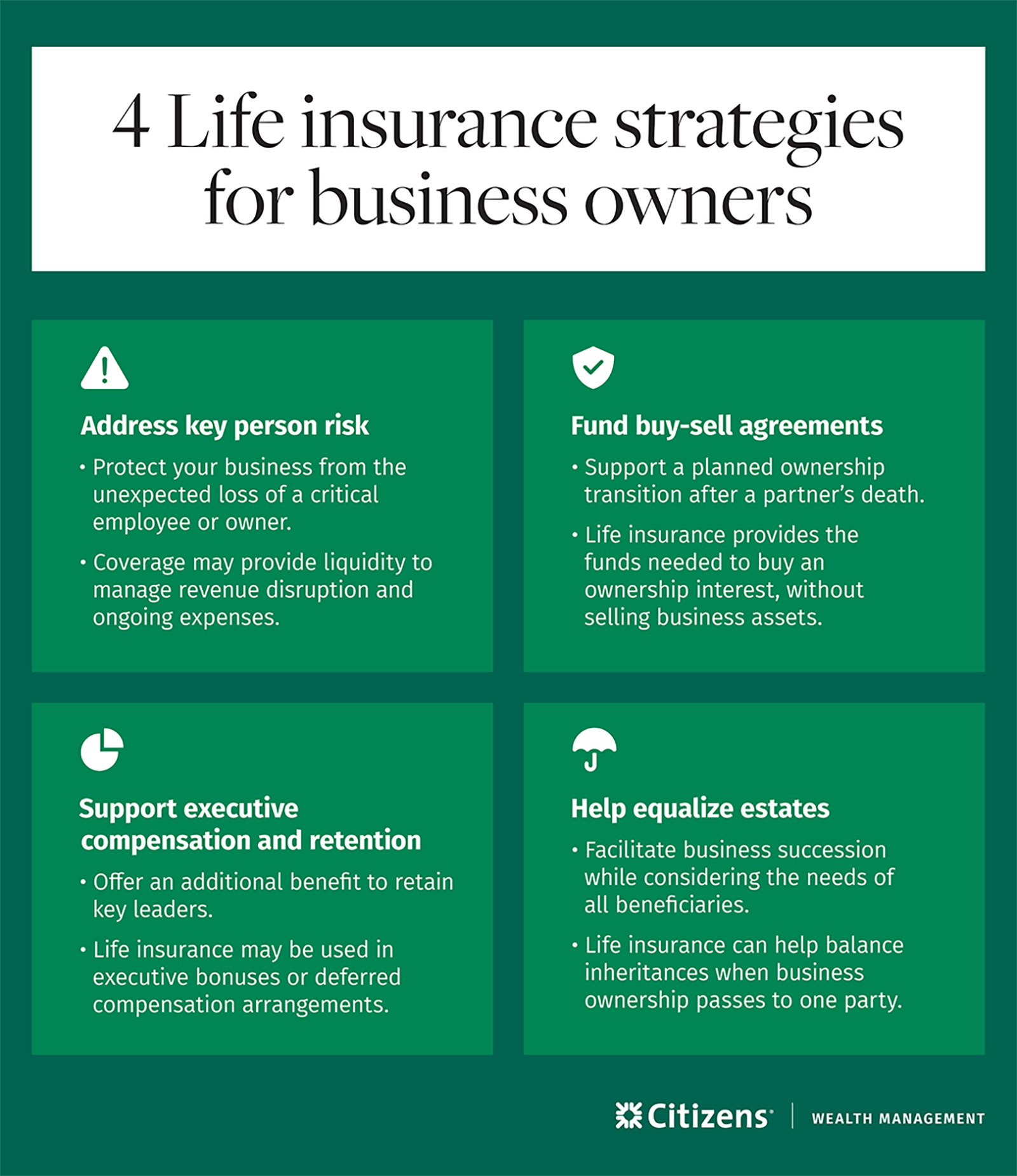
Life insurance can help protect your business in a number of ways, from managing cash flow issues to bolstering employee retention. Here are some of the strategies your business may want to consider as you plan for the future.
Key person insurance
Key person insurance helps protect a business if an owner or other high-value member of the company passes away.
A "key person" may be an owner or outside investor who provides the capital to pay salaries, purchase equipment and handle any other costs that keep the business running. Additionally, it could include executives or managers who bring unique skills and experience that cannot be easily replaced. The payout from a life insurance policy is intended to help the business to recruit and hire a replacement or make up for any short-term loss of income that their passing creates.
In the case of key person insurance, the business typically owns the policy, pays premiums on behalf of the insured person and acts as the beneficiary when they pass away. The amount of coverage that the business takes out depends on the individual.
For example, if a small software company estimates it would take six months to find a new director, the team will need to calculate the total cost of recruiting and onboarding someone new to serve in that role, and cover the cost of any potential clients lost as a result of their absence.
Buy-sell agreement funding
If a business is owned by multiple partners, life insurance is often used to fund a buy-sell agreement. These agreements lay out what will happen if one of the owners dies or otherwise leaves the organization. They typically take the form of cross-purchase or entity-purchase agreements.
Cross-purchase agreement
In the case of a cross-purchase agreement, each owner pays for a policy on the other owners and becomes the beneficiary. If one of the owners dies, the payout from the life insurance policy allows the surviving partner or partners to buy the deceased's share of the business directly. Often, these arrangements are made when there are only two or three owners of the venture.
For example, if there are two owners of a restaurant valued at $2 million, each owner may be required to take out a $1 million policy that will enable the surviving owner to assume full control over the business if the other owner dies.
Entity-purchase agreement
Conversely, in an entity-purchase agreement, the business itself pays for the life insurance policies and, upon receiving the insurance proceeds, buys back the deceased owner's shares. The remaining partners end up acquiring a larger stake in the company because there are fewer ownership shares left after the buyback. Entity-purchase agreements tend to work better for organizations with more than two owners, as it requires the purchase of fewer policies.
Executive bonus plans and deferred compensation
Small businesses may also use life insurance as a recruitment and retention tool, especially for key executives. For instance, in an executive bonus plan, the business pays the employee a periodic bonus that covers the premium for a permanent life insurance policy. The employee owns the policy, names the beneficiaries and may have the ability to access the cash value through policy loans or withdrawals.
Deferred compensation programs use life insurance as a more indirect retention tool for executives. One example is a supplemental executive retirement plan, or SERP, in which an employer promises the executive a predetermined income stream that kicks in at a future date. The company purchases a permanent life insurance policy and taps into its cash value when the time comes to make those payments. Often, the executive loses all or part of their deferred compensation if they're terminated or voluntarily leave the company, providing them with an incentive to stay.
Estate equalization
By incorporating life insurance into their estate plan, a business owner can help ensure an equitable distribution of overall assets when they pass away. For example, consider a sole proprietor who has a son and daughter to whom he would like to leave his wealth.
Because the daughter helps him manage the business and wants to take over as owner when he dies, he gives the business to her in his will. His son has no such desire to be involved in the company, so the father takes out a life insurance policy that's equal to the value of the business.
This eliminates the need for the more actively involved beneficiary to sell assets or take on large amounts of debt to buy out the other heir's share.
Integrate life insurance into your succession plan
If you're a business owner, life insurance is an important investment that enables the continuity of your company while protecting your employees and family members. It can also help ensure that you attract and keep the high-value employees who give your business a valuable edge.
As your business grows and changes, your strategy may need to change with it. With access to a team of specialists, including Citizens Business Banking Relationship Managers, a Citizens Wealth Advisor can help you create a plan tailored to both your business strategy and personal financial goals.
Related topics

Self-employed retirement plans: 6 options to consider
There are several retirement savings options designed specifically for self-employed individuals and small business owners.

Insurance planning essentials: protecting your family's financial future
Life, disability, and long-term care insurance are key types to consider in a comprehensive financial plan.

Top retirement risks and how to prepare for them
Learn how to prepare for common retirement risks to help secure your financial future.
© Citizens Financial Group, Inc. All rights reserved. Citizens Bank, N.A. Member FDIC
Disclaimer: Citizens Wealth Management does not provide legal or tax advice. The information contained herein is for informational purposes only as a service to the public and is not legal advice or a substitute for legal counsel. You should do your own research and/or contact your own legal or tax advisor for assistance with questions you may have on the information contained herein.
Insurance products are made available through Citizens Securities, Inc., a licensed insurance agency, doing business as Citizens Financial and Insurance Agency. CA Insurance License OL81568
Insurance contracts may contain exclusions, limitations, reductions of benefits and terms for keeping them in force.
Citizens Wealth Management (in certain instances d/b/a Citizens Private Wealth) is a division of Citizens Bank, N.A. ("Citizens"). Securities, insurance, brokerage services, and investment advisory services are offered by Citizens Securities, Inc. ("CSI"), a registered broker-dealer (Branch address: One Citizens Bank Way, Johnston RI 02919) and SEC registered investment adviser - Member FINRA/SIPC. Investment advisory services are also offered by Citizens Private Wealth, LLC ("CPW"), an SEC-registered investment adviser (see Form ADV Part 2A for details). CSI and CPW are affiliates of Citizens. Banking products and trust services are offered by Citizens. For deposit products, Member FDIC.
SECURITIES, INVESTMENTS AND INSURANCE PRODUCTS ARE SUBJECT TO RISK, INCLUDING PRINCIPAL AMOUNT INVESTED, AND ARE:
· NOT FDIC INSURED · NOT BANK GUARANTEED · NOT A DEPOSIT · NOT INSURED BY ANY FEDERAL GOVERNMENT AGENCY · MAY LOSE VALUE