
How to save money: 10 tips that actually work

Saving money starts with a few foundational habits: automating transfers, building a budget around your actual spending, setting specific goals with target dates, cutting recurring expenses you've forgotten about and tackling high-interest debt. Together, these strategies form a system that moves your money toward your goals without relying on willpower alone.
Key takeaways
- Small actions might not seem like they will make much of a difference, but the savings can add up over time if you are consistent.
- Cutting back on or eliminating incidental purchases, unused subscriptions and other nonessential spending may help free up money that can be used to grow your savings.
- A budget can give you a clear picture of how much money you have coming in and where it's going so you can create a plan to reach your savings goals.
- Having both a checking and savings account could make it easier to track your savings progress and know how much you have available for your everyday spending needs.
Have you ever set a savings goal, made some progress and then later gave up? Figuring out how to save money can feel overwhelming because savings advice is often presented as a long list of sacrifices that are difficult to keep up with. An easy-to-follow system that fits your lifestyle may help change that.
Recent Citizens Savings Tracker®1 data indicates that while consumers continue to set savings goals, fewer are reaching those goals on time, with on-target completion falling from 30% to 23% since early 2025.*
Saving money is much easier when it becomes part of your everyday financial life instead of an afterthought. This guide offers practical tips that can make saving easier. They are most effective when used together instead of individually to grow your savings and reach your financial goals.
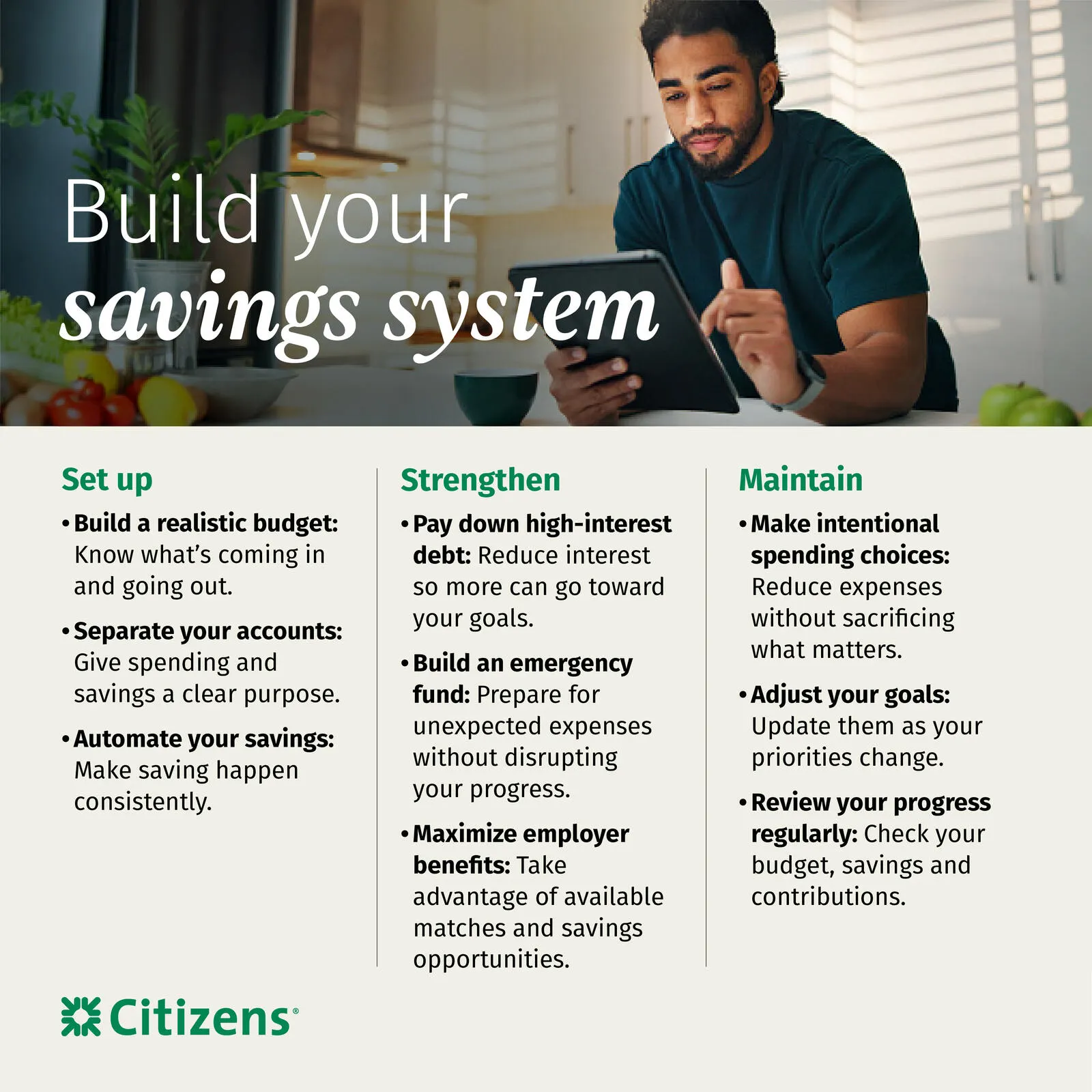
Tip 1: Automate your savings on payday
One of the easiest ways to save money is to make sure it happens automatically. If your company offers direct deposit, see if you can split your paycheck between your checking and savings account. Otherwise, many banks set up automatic transfer from your checking account to your savings account on the same days every month. You can schedule these transfers in advance, so you don't even have to think about them.
This strategy is often referred to as "paying yourself first." You contribute to your savings when you get paid and use the rest for your monthly expenses. Automating your savings helps ensure your account continues to grow, even when you are busy or forget to make deposits.
"Everyday spending is crowding out saving right now," says Chris Powell, Head of Deposits at Citizens. "People are still setting goals, but fewer of them are hitting those goals on time. Automate the transfer and keep the number somewhere you can see it. A savings tracker does that well, and honestly any tool that keeps the goal in front of you works on the same principle."
Tip 2: Build a budget that reflects how you actually spend
A budget is a written plan for what you will do with your money. It can also help you grow your savings. When you know how much you need to cover your expenses, it's easier to see how much you can set aside each month in savings.
Here are some budgeting strategies to consider:
- 50/30/20 budget: Divide your after-tax income into three categories: 50% for needs, 30% for wants and 20% for savings.
- Zero-based budget: Give every dollar a purpose so your income minus expenses, savings and debt equals zero.
- Pay-yourself-first budget: Set aside part of your income for savings before using the rest for expenses.
- Envelope budgeting method: Place the cash you need for each budget category (groceries, entertainment, etc.) in a digital or real envelope each month. Once an envelope is empty, you stop spending in that category until the next month.
Review your bank account transactions to help you see where your money is going. With Citizens, you can easily access your account information through online banking or the Citizens mobile banking app.
Make sure the budget you create is realistic. Saying you are going to save 30% of your income might sound like a great goal, but it may be hard to achieve if it doesn’t leave enough to cover your needs.
Tip 3: Set specific savings goals with target dates
A simple way to stay motivated is to know what you’re saving for. For example, you might be saving for a new car, a down payment on a home or an educational fund. Without a specific savings goal, it’s easy to spend the money you were saving on something else.
After you've identified a goal, determine how much you need to save and when you want to reach it. For example, if you want to save for new kitchen appliances, you might set a goal of $5,000 with a timeline of one year. That means you would need to save about $417 per month.
Tip 4: Audit your subscriptions and recurring expenses
Does it seem like nearly everything is a subscription these days? Streaming platforms, software, games, news publications, gym memberships, credit monitoring, shopping memberships and more can take a bigger bite out of your budget than you might think. It’s also easy to forget about a subscription and continue paying for it after you stop using it.
Periodically review your subscriptions and recurring expenses and consider whether or not you still need them. Your bank account and credit card statements can help you identify recurring charges. Consider canceling any unused or duplicate services to free up money for your savings. You may also be able to find free alternatives for services you use infrequently.
Tip 5: Reduce or eliminate high-interest debt
The cost of high-interest debt can really add up over time. Credit card interest, for example, typically compounds daily. If you carry a balance, interest will continue to be added to what you owe. With just a $1,000 balance on your credit card for a year with a 20% APR (annual percentage rate) that compounds daily, you'll end up paying $221.34 in interest over the course of 12 months. The more you have to repay, the less you may have for your savings goals. Paying down or eliminating high-interest debt can result in significant savings.
"Start with the boring stuff," says Powell. "Read your statements line by line, cancel the subscriptions you forgot about, and be honest about what debt you are carrying and at what rate. That hour usually pays for itself."
Consolidating high-interest debt with a lower-interest loan is another option to consider. Personal loans are often used for this purpose, but home equity loans and home equity lines of credit (HELOCs) can also be used if you have sufficient equity in your home.
Tip 6: Build an emergency fund before investing
An emergency fund is money you set aside for unexpected expenses, like a car repair, medical bills or a new HVAC unit. It can also give you a financial buffer if you experience a job loss. Having an emergency fund may help you avoid turning to credit cards, loans or funds you were saving for a goal when you have an urgent need.
Financial experts often recommend keeping three to six months of living expenses in an emergency fund. Regular contributions can help you build an emergency fund over time. Consider starting with a modest goal, like $500. Then raise it a little higher. Achieving smaller goals along the way can help you stay motivated as you build your financial safety net.
Tip 7: Separate your spending money from your savings
Keeping money you are setting aside separate from your checking account may help you reach your savings goals faster. When your savings aren't mixed in with the money you use for everyday expenses, you may be less tempted to spend it. Separating your funds also makes it easy to track progress toward your goals.
One of the best places to save money is a standard savings account. They usually have low or no minimum balance requirements, and your funds can also earn a small amount of interest. If you are considering saving vs. investing, keep in mind that investments are subject to market fluctuations, meaning your balance can go up or down depending on economic conditions.
Another option is a high-yield savings account, which typically offers a higher interest rate than a traditional savings account. However, some accounts may require you to maintain a minimum balance to earn the advertised APY.
"Savings is where people leave money on the table," says Powell. "Look at where your cash is sitting and what it is earning. If it is in a basic account, a high-yield savings or money market account will usually do better while still letting you get at the money."
Tip 8: Reduce everyday discretionary spending with a plan
According to the Citizens' Next Gen: Future of Success Survey, only 9% of young adults feel fully in control of their spending. Our survey also found that 54% cited impulse shopping as a challenge, and 47% admitted they don't budget. The research also found that more than half (57%) say stress about money affects their mental health, and 44% succumb to social pressures that influence their overspending.
Finding small ways to spend less may help free up money to grow your savings. For example, you might:
- Use a shopping list to avoid impulse purchases
- Limit food delivery and takeout
- Wait 24 hours before making nonessential purchases
- Buy used items when possible
- Bring lunch and coffee from home
- Cut back on drinks and snacks while you are on the go
- Look for affordable entertainment in your community
Proactively finding ways to save is better than waiting until your checking account balance is low and you have to cut back. Each expense you reduce or eliminate might not seem like much, but small, consistent reductions can add up over time.
Tip 9: Take advantage of employer benefits and matching programs
Many employers that offer 401(k) retirement accounts will match a portion of the contributions you make. This benefit could help grow your retirement savings faster. Some employers also contribute to their employees' HSA accounts or offer commuter benefits and other tax-advantaged savings programs.
Leaving employer benefits on the table can cost you. Find out what your employer offers so you can understand your options. A small investment of time could be well worth it.
Tip 10: Review and adjust your savings plan regularly
Your income, expenses and goals are likely to change over time. As your financial situation evolves, you may want to update your savings plan, so it continues to serve your needs.
If you're wondering how often you should monitor your bank account, this schedule can help you identify when adjustments are needed:
- Monthly check-in on spending: Look for unused subscriptions, increases in incidental spending and recent impulse purchases.
- Quarterly review of savings progress: See if you need to contribute more or cut back on spending to reach your goals.
- Annual goal reset: Determine whether your goal is still worth pursuing or it's time to set a new one.
Tools like Citizens Savings Tracker® are available to help you track your savings progress over time. Regularly reviewing your savings plan can help you keep the momentum going as you work toward your financial goals. Keep in mind that a savings review will look different depending on the stage of life you're in. You will likely have different financial needs when you're starting a family than when you're approaching an empty nest.
Saving money is a system, not a sacrifice
Saving money doesn't have to be hard when it becomes part of your daily routine. The simple money-saving strategies in this article are easy to implement and don't take too much time. They may even become second nature after a while, so you don't have to think about them as much. When combined with the right tools and bank accounts, these habits can help you build your savings steadily and make it easier to reach your goals.
A Citizens account can serve as the operational hub for your savings system. Learn more about our savings account options to find the best fit for your needs. Citizens customers may even be eligible for additional savings offers.
Frequently asked questions
How much money should I save each month?
A common guideline is to save 20% of your after-tax income, based on the 50/30/20 budget rule. However, the right amount depends on your income, expenses and goals. If 20% isn't realistic right now, start with a smaller percentage and increase it as your financial situation improves. Even saving $25 or $50 per paycheck can build a meaningful cushion over time.
Should I save money or pay off debt first?
It depends on the type of debt. High-interest debt like credit cards can cost you more in interest than you'd earn in a savings account, so paying it down first often makes sense. However, building a small emergency fund of $500 to $1,000 before aggressively paying down debt can help you avoid going further into debt when unexpected expenses come up.
What type of account is best for saving money?
A standard savings account is a good starting point because of low minimum balance requirements and easy access to your funds. A high-yield savings account may earn more interest, and a money market account offers higher rates with the flexibility to write checks. The best choice depends on how quickly you need access to the funds and how much you can set aside.
Related topics

How to create a budget
A budget is an essential tool for money management and reaching your financial goals. Create your budget using these five steps.

How to start an emergency savings fund
Learn how to start an emergency savings fund so you have a financial safety net for unexpected expenses or for security.

Short-term, midterm and long-term savings goals: How to save
Regardless if your goal is weeks or years away, learn how to keep your savings on the right track.
© Citizens Financial Group, Inc. All rights reserved. Citizens Bank, N.A. Member FDIC
1 Subject to account eligibility. Only available on the Citizens Bank Mobile Banking application. Text and data rates may apply.
* Citizens' Next Gen: Future of Success Survey was conducted by Researchscape among 2,309 U.S. adults aged 18-34. The survey was fielded from August 29 to September 11, 2025, using an online survey. Data has been weighted. Weighting data is a statistical technique used to adjust survey data after it has been collected in order to improve the accuracy of survey estimates.
Disclaimer: The information contained herein is for informational purposes only, as a service to the public, and is not legal advice or a substitute for legal counsel. You should do your own research and/or contact your own legal or tax advisor for assistance with questions you may have on the information contained herein.